
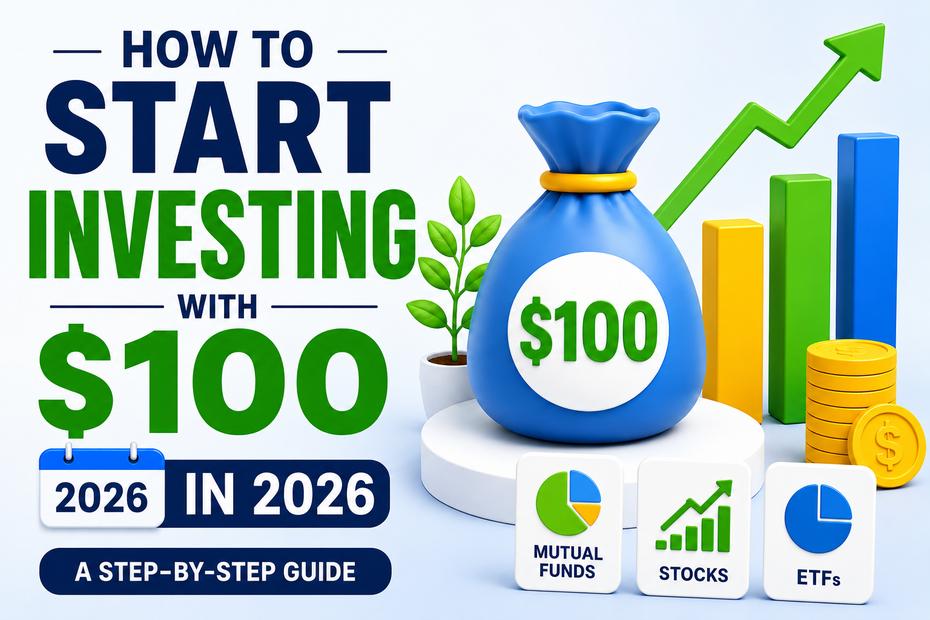
Many people think investing is just for those who have thousands to spare. This belief is one of the biggest myths that keeps people from building wealth. Thanks to modern investing platforms, fractional shares, ETFs, and low-cost index funds, you can start investing with as little as $100.
If you’re asking how to start investing with $100 in 2026, you’re already taking the most crucial step: getting started. While $100 won’t make you rich overnight, it can help you establish investing habits, learn how the market works, and begin growing your money through long-term investments.
This guide explains how to invest your first $100, where to put it, what mistakes to avoid, and how to turn a small investment into significant wealth over time.
Why Investing $100 Is Enough to Get Started in 2026
One of the greatest advantages of modern investing is accessibility. Years ago, investors often needed thousands of dollars to buy stocks or mutual funds. Today, many brokers let you buy fractional shares, allowing you to own a piece of companies like Apple, Microsoft, or Amazon with only a few dollars.
Starting with $100 has several benefits:
- Learn to invest without risking large amounts
- Develop habits for building long-term wealth
- Benefit from compound growth over time
- Build confidence in managing investments
- Create a base for future contributions
The amount you start with is far less important than being consistent in your investing strategy.
What You Should Do Before Investing Your First $100
Before investing in the stock market, ensure your financial foundation is stable.
Pay Off High-Interest Debt
If you have credit card debt with interest rates above 20%, paying that off may give you a better financial return than investing.
For example, earning 8% annually from investments doesn’t make sense if you’re paying 24% interest on debt.
Build a Small Emergency Fund
Unexpected expenses happen. Having emergency savings can prevent you from selling investments during market downturns.
A good goal is to save enough to cover at least one month of essential expenses.
Define Your Investment Goal
Ask yourself why you’re investing.
Common goals include:
- Retirement savings
- Building long-term wealth
- Buying a house
- Funding education
- Financial independence
Your goal will shape your investment strategy and timeline.
Step 1: Decide Why You Are Investing
Successful investing begins with clarity.
Someone investing for retirement in 30 years can generally accept more market volatility than someone saving to buy a house in two years.
Ask yourself:
- When will I need this money?
- How much risk can I handle?
- Am I investing for growth or income?
Most beginners with a long timeline benefit from focusing on growth-oriented investments.
Step 2: Choose the Right Investment Account
The next step is to pick an account that matches your goals.
Brokerage Account
A brokerage account lets you buy stocks, ETFs, index funds, and other investments.
Benefits include:
- Flexibility
- No contribution limits
- Easy access to funds
This is often the simplest option for beginners.
Retirement Account
If retirement is your main goal, retirement-focused accounts may offer tax benefits depending on your country.
These accounts can help maximize long-term growth through tax advantages.
Robo-Advisor
A robo-advisor automatically creates and manages a diversified portfolio based on your goals and risk tolerance.
Benefits include:
- Automatic portfolio management
- Diversification
- Beginner-friendly experience
For investors who prefer not to choose investments themselves, robo-advisors can be a practical solution.
Step 3: Pick the Best Investment for $100
One common beginner question is:
“What’s the best way to invest $100?”
Let’s look at the top options.

Index Funds
Index funds are highly recommended for beginners.
They track a market index and give exposure to many companies through a single investment.
Benefits:
- Diversification
- Low fees
- Strong long-term performance
- Simple investing approach
Many financial experts see index funds as one of the best long-term wealth-building tools available.
If you’re unsure whether to choose index funds and ETFs, understanding the key differences between these popular investment options can help you make a more informed decision as a beginner investor.
ETFs (Exchange-Traded Funds)
ETFs work like index funds but trade like stocks.
Advantages include:
- Instant diversification
- Low expense ratios
- Easy buying and selling
- Suitable for small investments
Many beginners start with broad-market ETFs because they provide exposure to hundreds or thousands of companies.
Fractional Shares
Fractional shares let investors buy a portion of a stock.
Instead of needing hundreds of dollars to buy one share, you can invest smaller amounts.
Benefits:
- Access to expensive companies
- Flexible investing
- Ideal for beginners with limited funds
High-Yield Savings Accounts
If your investment timeline is under three years, a high-yield savings account might be better than stocks.
Benefits:
- Lower risk
- Liquidity
- Stable returns
This option suits short-term goals best.
Step 4: Open an Investment Account
Opening an investment account usually takes less than 15 minutes.
Most platforms require:
- Identification
- Contact information
- Bank account details
- Basic financial information
After your account is approved, transfer your $100 and get ready to make your first investment.
Step 5: Invest Your First $100
Many beginners overthink this step.
A simple strategy could look like this:
Option A: Invest All $100 in a Broad Market ETF
This gives you diversification across many companies.
Option B: Invest in an Index Fund
A low-cost index fund provides broad market exposure and long-term growth potential.
Option C: Split Your Investment
Example:
- $50 in an ETF
- $50 in another diversified investment
Regardless of what you choose, diversification is key.
Avoid putting your entire $100 into a single risky stock.
Step 6: Set Up Automatic Investing
One of the most effective investing habits is automation.
Even small contributions can lead to meaningful results over time.
Consider automatic investments of:
- $10 per week
- $25 per month
- $50 per month
Consistency is more important than trying to time the market.
Investors who contribute regularly tend to do better than those who wait for the “perfect” moment to invest.
How Much Can $100 Grow Over Time?
The real advantage of investing comes from compound growth.
Imagine:
- Initial investment: $100
- Monthly contribution: $50
- Annual return: 8%
- Time horizon: 30 years
Over several decades, consistent contributions can grow into tens of thousands of dollars.
This shows why starting early is often more important than starting with a large amount.
The real power behind long-term investing comes from compound interest, which allows your earnings to generate additional earnings over time and accelerate portfolio growth.
Best Investment Strategies for Beginners in 2026
Dollar-Cost Averaging
Dollar-cost averaging involves investing a fixed amount on a regular basis.
Benefits include:
- Reduces emotional decision-making
- Avoids timing mistakes
- Encourages discipline
This is one of the most effective strategies for beginners.
Long-Term Investing
Long-term investors focus on years or decades, not days or weeks.
Advantages:
- Reduced stress
- Lower trading costs
- Greater chance for compound growth
Historically, patient investors have been rewarded more consistently than short-term traders.
Diversification
Diversification means spreading investments across various assets.
Benefits:
- Reduced risk
- Improved portfolio stability
- Protection against individual company declines
Diversification is a key part of successful investing.
Common Investing Mistakes to Avoid
Waiting Until You Have More Money
Many people hesitate to invest because they believe $100 isn’t enough.
The biggest mistake is not starting at all.
Trying to Get Rich Quickly
High-risk investments that promise huge returns often result in significant losses.
Focus on steady long-term growth instead.
Following Social Media Hype
Popular stocks trending online can be very volatile.
Always do your own research before investing.
Investing Without a Plan
Successful investors typically have:
- Clear goals
- Consistent contributions
- Long-term discipline
Without a plan, emotional decisions can become more likely.
Panic Selling During Market Declines
Market downturns are normal.
Selling investments out of fear can lock in losses and hinder recovery gains.
Should You Invest in Stocks, ETFs, or Index Funds?
For most beginners, diversified investments are often better than individual stocks.
Individual Stocks
Pros:
- Potentially higher returns
- Ownership in specific companies
Cons:
- Higher risk
- Requires more research
ETFs
Pros:
- Diversification
- Flexibility
- Low costs
Cons:
- Market risk still exists
Index Funds
Pros:
- Broad diversification
- Simplicity
- Long-term growth potential
Cons:
- Market fluctuations
For many beginner investors, index funds and ETFs offer the best balance between growth and risk management.
Can You Become Wealthy Starting With Just $100?
The simple answer is yes, but not because of the $100 itself.
Many people focus on the amount they start with, but successful investing usually relies on consistency rather than a large initial investment. The first $100 is important because it helps you build the habit of investing and puts your money to work instead of letting it sit idle.

Imagine two investors:
- Investor A starts with $100 today and invests a small amount every month for the next 20 years.
- Investor B waits five years until they have $5,000 before starting.
In many cases, Investor A can end up with more wealth because they gave their investments more time to grow through compound interest.
The wealth-building formula is surprisingly simple:
- Start early
- Invest consistently
- Stay invested long term
- Increase contributions when your income grows
- Avoid emotional decisions during market fluctuations
Over time, even small investments can grow into a substantial portfolio. The goal isn’t to turn $100 into a fortune overnight. Instead, it’s about creating a system that lets your wealth grow year after year.
The most successful investors often didn’t begin with large sums of money. They started with what they had and remained disciplined over decades.
Building wealth is rarely about starting with a large amount of money. Instead, it often comes down to following proven wealth-building principles, staying consistent with your investments, and maintaining a long-term perspective through different market conditions.
A Simple Beginner Investment Plan for 2026
If you’re completely new to investing and want a straightforward plan, this can help you get started.
Step 1: Build a Small Financial Safety Net
Before investing, ensure you have enough cash for unexpected expenses. This helps prevent you from selling investments during emergencies.
Step 2: Open a Low-Cost Investment Account
Choose a reputable brokerage platform that offers:
- Low fees
- Fractional shares
- ETFs and index funds
- Easy-to-use investment tools
Step 3: Invest Your First $100
Instead of chasing the latest trending stock, consider starting with a diversified investment such as:
- A broad-market ETF
- An S&P 500 index fund
- A total stock market fund
These options provide exposure to hundreds or even thousands of companies through a single investment.
Step 4: Automate Your Contributions
Set up recurring investments, even if they’re small.
Examples:
- $10 per week
- $25 every two weeks
- $50 per month
Automating contributions helps eliminate guesswork and keeps your investment strategy consistent.
Step 5: Ignore Short-Term Market Noise
Markets naturally rise and fall over time. New investors often make the mistake of reacting to every headline or market drop.
Instead, focus on your long-term goals and continue investing regularly.
Step 6: Increase Investments Over Time
Whenever your income increases, consider directing a portion of that increase toward your investments.
For example:
- Got a raise? Increase monthly investments.
- Received a bonus? Invest part of it.
- Paid off debt? Redirect those payments toward your portfolio.
Small increases can make a significant difference over time.
Key Takeaways
Before you start investing, remember these important principles:
- You do not need thousands of dollars to begin investing.
- A $100 investment can be enough to start building wealth.
- Index funds and ETFs are often great choices for beginners.
- Consistent investing usually matters more than trying to time the market.
- Compound growth becomes more powerful the longer you stay invested.
- Diversification can help reduce risk.
- Long-term investors often perform better than those who frequently buy and sell.
The sooner you start, the more time your money has to grow.
Frequently Asked Questions
Is $100 really enough to start investing?
Yes. Many brokerages allow investors to buy fractional shares and invest in ETFs or index funds with relatively small amounts of money.
What is the best investment for beginners with $100?
For most beginners, diversified investments like broad-market ETFs and index funds are often considered among the best options because they provide instant diversification and lower risk compared to individual stocks.
Can I lose money investing $100?
Yes. All market-based investments come with some level of risk. However, diversification and a long-term approach can help reduce the impact of short-term market fluctuations.
How often should I invest?
Many investors choose a regular schedule, such as weekly, biweekly, or monthly contributions. Consistency is often more important than the exact amount invested.
Should I invest $100 all at once or gradually?
If you already have the $100 available, investing it immediately lets your money start working sooner. You can then add future contributions on a regular basis.
How long should I stay invested?
Investing usually works best when viewed as a long-term strategy. Many financial experts recommend staying invested for years or even decades to maximize the benefits of compound growth.
Final Thoughts
Learning how to start investing with $100 in 2026 is not about finding a secret strategy or predicting the next winning stock. It’s about taking the first step toward building long-term wealth.
Modern investing has made it possible for almost anyone to become an investor, regardless of their budget. Whether you choose an ETF, index fund, or fractional shares, the most important decision is simply to get started.
A single $100 investment may not seem life-changing today, but the habits you build from that first investment can shape your financial future for years to come. By investing consistently, staying patient, and focusing on long-term growth, you open up the opportunity to benefit from one of the most powerful wealth-building tools available: compound interest.
The best time to start investing was years ago. The second-best time is today. Your first $100 could be the beginning of a journey toward greater financial security, independence, and wealth in the years ahead.
Written by Finphantix