
When it comes to building wealth in 2026, investors have more options than ever. Three of the most popular choices are ETFs, Index Funds, and Mutual Funds.
A simple Google search for terms like ETF vs Index Fund vs Mutual Fund, best investment option in 2026, and ETF or Mutual Fund which is better shows that millions of investors are trying to understand the differences.
The truth is all three can help grow your money, but they work differently and suit different types of investors.
In this detailed guide, you’ll learn:
- What is an ETF?
- What is an Index Fund?
- What is a Mutual Fund?
- ETF vs Index Fund vs Mutual Fund comparison
- Which option is best for beginners?
- Which investment offers better long-term returns?
Let’s start with the basics.
What Is an ETF?
An ETF (Exchange-Traded Fund) is a collection of investments that trades on a stock exchange like a stock.
When you buy an ETF, you purchase a mix of assets such as stocks, bonds, or commodities in one investment.
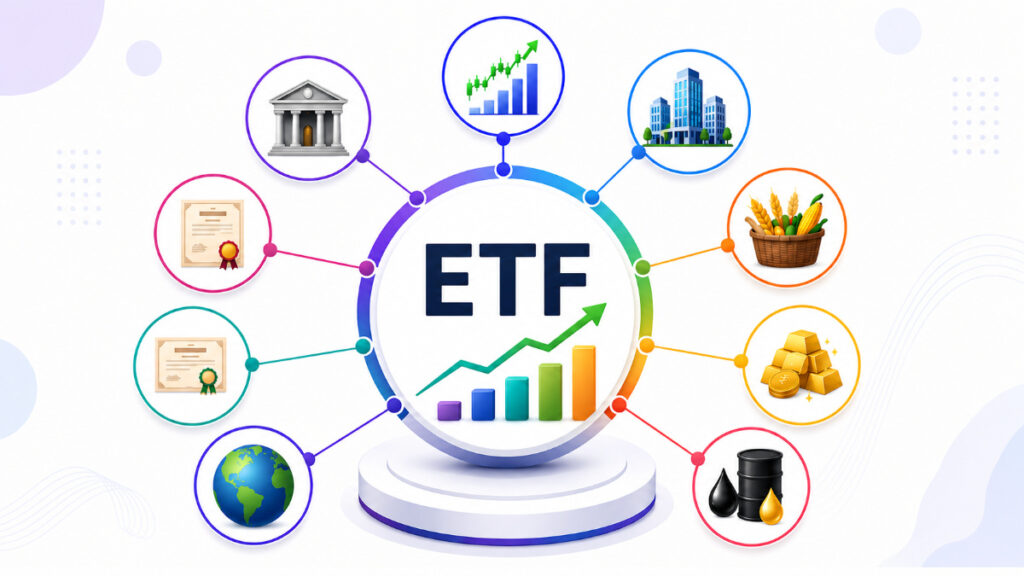
Popular examples include:
- S&P 500 ETFs
- Nasdaq 100 ETFs
- Total Market ETFs
- Dividend ETFs
Benefits of ETFs
- Lower expense ratios
- High liquidity
- Real-time trading
- Tax efficiency
- Diversification
Drawbacks of ETFs
- Brokerage account required
- Market fluctuations throughout the day
- Some ETFs have lower trading volume
Because of their low costs and flexibility, ETFs have become one of the fastest-growing investment products worldwide.
What Is an Index Fund?
An Index Fund is a type of mutual fund that tracks a market index.
Instead of trying to beat the market, an index fund simply follows it.
Examples:
- S&P 500 Index Fund
- Nasdaq Index Fund
- Total Stock Market Index Fund
Benefits of Index Funds
- Extremely low fees
- Passive management
- Easy for beginners
- Consistent long-term performance
- Automatic diversification
Drawbacks of Index Funds
- Cannot trade during market hours
- No opportunity to outperform the market
- Less flexibility than ETFs
For investors who prefer a “buy and hold” strategy, index funds remain one of the best investment options in 2026.
What Is a Mutual Fund?
A Mutual Fund combines money from many investors and is managed by professional fund managers.
Unlike index funds, most mutual funds are actively managed.
The goal is usually to outperform a benchmark index.
Benefits of Mutual Funds
- Professional management
- Access to specialized sectors
- Automatic diversification
- SIP and recurring investment options
Drawbacks of Mutual Funds
- Higher fees
- Potential underperformance
- Less tax efficient
- Limited trading flexibility
While some actively managed funds outperform the market, many do not beat low-cost index funds over long periods.
ETF vs Index Fund vs Mutual Fund: Quick Comparison
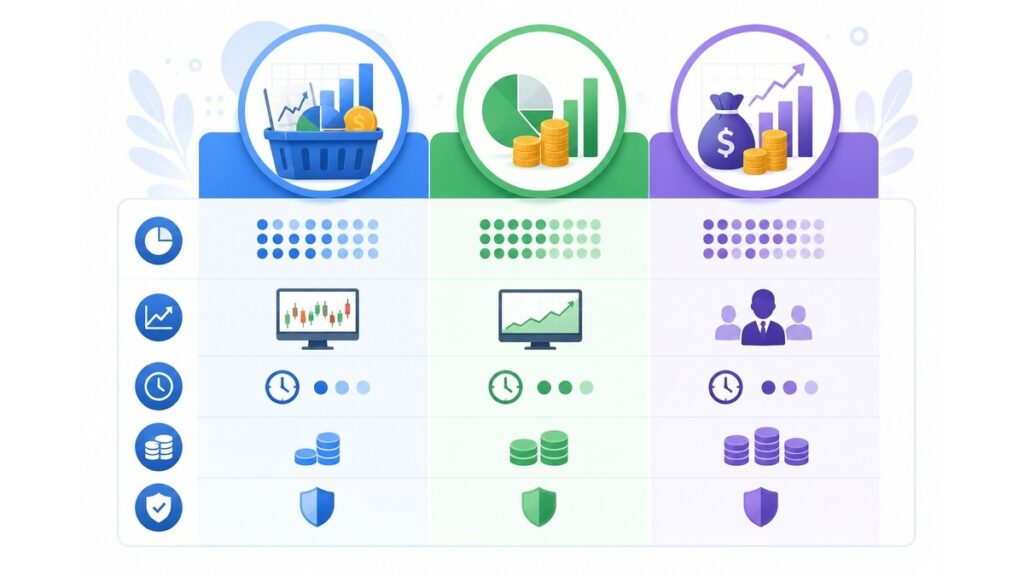
| Feature | ETF | Index Fund | Mutual Fund |
|---|---|---|---|
| Management Style | Passive | Passive | Active/Passive |
| Trading | Throughout the day | End of day | End of day |
| Expense Ratio | Very Low | Low | Higher |
| Tax Efficiency | High | Moderate | Lower |
| Minimum Investment | Usually One Share | Varies | Varies |
| Flexibility | High | Medium | Low |
| Diversification | High | High | High |
| Suitable for Beginners | Yes | Yes | Yes |
ETF vs Index Fund vs Mutual Fund: Cost Comparison
One of the biggest factors affecting long-term wealth is fees.
Imagine two investors earn identical returns.
Investor A pays 0.05% annually.
Investor B pays 1.00% annually.
Over 20 years, Investor A can end up with significantly more wealth simply because of lower costs.
This is why many financial experts prefer:
Low-Cost ETFs
and
Low-Cost Index Funds
over expensive actively managed funds.
Which Offers Better Returns?
This is perhaps the most searched question online:
ETF vs Index Fund vs Mutual Fund returns
The answer depends on the specific fund.

However, historical evidence shows:
- Most index funds outperform many active mutual funds over long periods.
- ETFs tracking major indexes generally produce similar returns to index funds.
- Some mutual funds outperform temporarily, but maintaining that advantage consistently is difficult.
For long-term investors, minimizing costs often matters more than chasing the highest-performing fund.
ETF vs Index Fund vs Mutual Fund: Real-World Example
Suppose three investors each invest $10,000 in 2026.
Investor A Chooses an ETF
Investor A buys a broad-market ETF that tracks the S&P 500. The fund has very low fees and can be traded anytime during market hours.
Investor B Chooses an Index Fund
Investor B invests in an Index Fund tracking the same index. The investment is automatically managed and designed for long-term growth.
Investor C Chooses an Active Mutual Fund
Investor C selects an actively managed Mutual Fund with higher management fees. The fund manager tries to beat the market.
Over the long term, the results will depend on market performance, fees, and investment discipline. In many cases, low-cost ETFs and Index Funds can have an edge because lower expenses allow investors to keep more of their returns.
Key Takeaway
When comparing ETF vs Index Fund vs Mutual Fund, investors should focus on:
- Investment costs
- Long-term returns
- Diversification
- Tax efficiency
- Ease of investing
Choosing the right fund is often more important than trying to predict short-term market movements.
ETF vs Index Fund vs Mutual Fund: Which One Should You Choose in 2026?
| Investor Type | Best Choice |
|---|---|
| Beginner Investor | Index Fund |
| Long-Term Investor | ETF or Index Fund |
| Hands-On Investor | ETF |
| Passive Investor | Index Fund |
| Active Strategy Investor | Mutual Fund |
| Cost-Conscious Investor | ETF |

Why ETFs Are Becoming More Popular in 2026
Several trends are driving ETF growth globally:
Lower Costs
Many ETFs offer expense ratios close to zero.
Greater Flexibility
Investors can buy and sell throughout the trading day.
Broad Market Exposure
One ETF can provide access to hundreds or thousands of companies.
Technology and Accessibility
Modern investment platforms make ETF investing easier than ever.
Because of these advantages, ETF assets continue to grow worldwide.
Why Index Funds Remain a Favorite
Despite ETF growth, index funds remain extremely popular.
Reasons include:
- Simplicity
- Automatic investing
- Long-term focus
- Low turnover
- Proven performance
Many investors prefer setting up automatic monthly contributions and letting compound growth work over decades.
When Mutual Funds Make Sense
Mutual funds are not necessarily bad investments.
They may be suitable when:
- You want professional management.
- You need exposure to niche sectors.
- You value active investment strategies.
- Your retirement plan offers excellent mutual fund choices.
The key is selecting funds with reasonable fees and a strong long-term record.
ETF vs Index Fund vs Mutual Fund for Beginners
For beginners, the best choice often comes down to simplicity and costs.
Choose ETFs If:
- You want flexibility.
- You understand stock market trading.
- You prefer low costs.
Choose Index Funds If:
- You want simplicity.
- You plan to invest regularly.
- You prefer passive investing.
Choose Mutual Funds If:
- You trust professional management.
- You want actively managed strategies.
- You’re comfortable paying higher fees.
Common Mistakes Investors Make
Chasing Performance
Buying funds solely because they performed well recently.
Ignoring Fees
Even small fee differences can have a major impact over decades.
Lack of Diversification
Putting all money into a single sector or fund.
Frequent Trading
Constantly buying and selling can hurt long-term returns.
Investing Without Goals
Every investment decision should align with your financial objectives.
ETF vs Index Fund vs Mutual Fund: Risks You Should Know
When comparing ETFs, Index Funds, and Mutual Funds, it’s easy to focus only on returns. However, experienced investors know that managing risk is just as important as making profits.
No matter which option you choose, every investment carries some level of risk. Understanding these risks can help you make better long-term decisions and avoid costly mistakes.
Market Risk
The biggest risk for most investors is market risk. If the overall stock market declines, the value of an ETF, Index Fund, or Mutual Fund can also fall.
Even funds that hold hundreds of companies are not completely safe during major market downturns. Diversification can reduce risk, but it cannot eliminate it.
Management Risk
This risk mainly applies to actively managed Mutual Funds.
A fund manager’s decisions directly impact performance. While some managers outperform the market for short periods, many struggle to maintain that edge over the long term.
That’s one reason why low-cost index investing has become more popular among long-term investors.
Liquidity Risk
Most large ETFs are highly liquid and easy to trade. However, some specialized or niche ETFs may have lower trading volumes.
In those cases, investors may not always be able to buy or sell shares at their desired price, especially during market volatility.
Tracking Error
Both ETFs and Index Funds aim to follow a benchmark index, but their performance may not always match it perfectly.
Small differences can happen due to fund expenses, portfolio rebalancing, cash holdings, and other operational factors.
Although tracking errors are usually minor, they are important to understand when comparing similar funds.
Behavioral Risk
One of the most overlooked risks is investor behavior.
Many investors buy when markets are rising and sell when markets are falling. Emotional decisions often hurt long-term returns more than market fluctuations themselves.
Successful investing usually rewards patience, consistency, and a long-term perspective.
The Bottom Line
Whether you choose an ETF, an Index Fund, or a Mutual Fund, understanding the risks is crucial. The best investment isn’t necessarily the one with the highest recent return, but the one that fits your goals, time frame, and risk tolerance.
Over the long run, disciplined investors who stay diversified and keep costs low often put themselves in the best position for financial success.
ETF vs Index Fund vs Mutual Fund: Which Is Better in 2026?
There is no universal winner.
For most investors:
ETFs offer flexibility and low costs.
Index Funds offer simplicity and long-term consistency.
Mutual Funds offer active management and specialized strategies.
If your goal is long-term wealth building, a diversified portfolio built around low-cost ETFs or index funds is often the preferred approach among many financial experts.
While choosing between ETFs, index funds, and mutual funds is important, understanding the basics of successful long-term investing is even more crucial. Learn how Benjamin Graham’s value investing philosophy shaped generations of investors, including Warren Buffett.
Frequently Asked Questions
Is ETF better than Mutual Fund?
In many cases, ETFs have lower fees and greater tax efficiency, making them attractive for long-term investors.
Are Index Funds safer than ETFs?
Both carry market risk. Safety depends more on the underlying investments than the structure itself.
Can ETFs outperform Index Funds?
If both track the same index, returns are usually very similar after fees.
Why are Mutual Funds more expensive?
Most mutual funds use active management, which increases operating costs.
Which is best for beginners in 2026?
Many beginners start with broad-market index funds or ETFs due to their simplicity and low expenses.
Final Thoughts
The debate over ETF vs Index Fund vs Mutual Fund will continue in 2026, but the most important factor isn’t choosing the perfect fund.
It’s starting early, investing consistently, and keeping costs low.
Whether you choose an ETF, an Index Fund, or a Mutual Fund, long-term success usually comes from discipline, diversification, and patience rather than trying to predict short-term market movements.
Written by Finphantix