
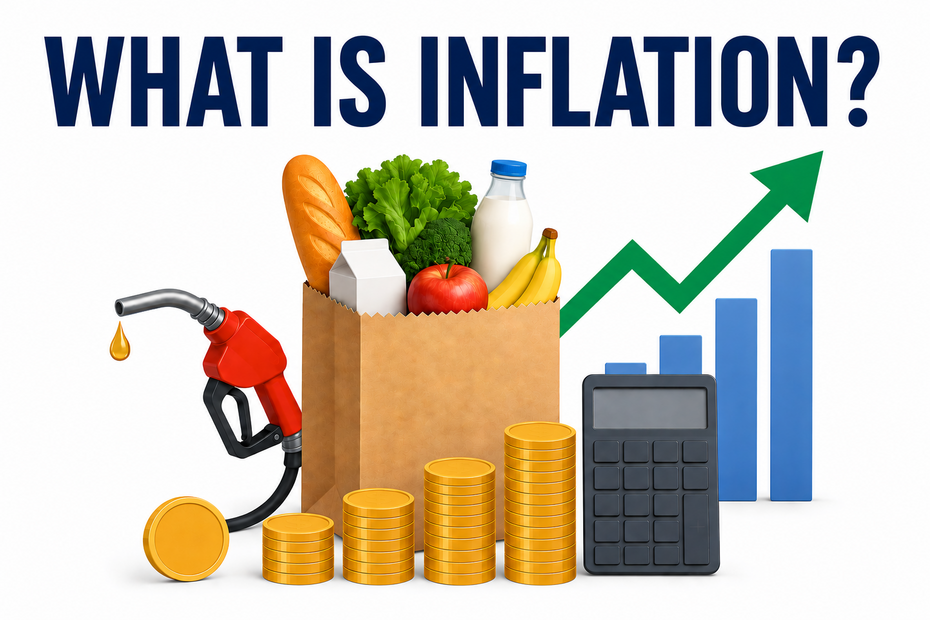
Inflation is a key concept in economics, personal finance, and investing because it directly impacts the value of money and everyday living costs. Grocery bills, housing prices, savings, investments, and interest rates are all influenced by inflation. Many people realize that prices are rising but do not fully grasp why inflation occurs or how it affects their financial future.
In simple terms, inflation means the steady increase in overall prices of goods and services over time, which lowers the purchasing power of money. As inflation goes up, the same amount of money buys fewer products and services than it did in the past. While moderate inflation is seen as a normal part of a healthy economy, consistently high inflation can raise living costs, diminish savings, and create difficulties for households, businesses, and investors.
Understanding inflation is crucial because it sheds light on how economies work and why governments and central banks make choices about interest rates and monetary policy. This knowledge helps people make better decisions about budgeting, saving, investing, borrowing, and planning for the long term.
In this complete expert guide, you’ll learn what inflation is, how it works, what causes it, the different types of inflation, how it is measured, its effects on individuals and businesses, its ties to interest rates and investments, and practical strategies to safeguard your money from inflation. Whether you are a student, investor, business owner, or simply looking to boost your financial understanding, this guide will give you a clear and thorough grasp of one of the most important economic concepts.
What Is Inflation?
Inflation is a key idea in economics, finance, and personal money management. It directly impacts the value of money, the cost of living, savings, investments, and long-term financial planning.
In simple terms, inflation is the ongoing increase in overall prices of goods and services over time. When inflation goes up, the purchasing power of money goes down. This means that the same amount of money buys fewer products and services than it did in the past.
For instance, let’s say you could purchase a complete grocery basket for $100 a few years ago. Due to inflation, that same basket might now cost $120. The products haven’t necessarily changed, but the value of money has fallen because prices have risen.
However, inflation isn’t just about one item becoming expensive. True inflation occurs when prices rise broadly across various sectors of the economy. This includes food, housing, transportation, healthcare, education, energy, and everyday services.
Economists track inflation by monitoring price changes in commonly bought goods and services. One of the most used measures is the Consumer Price Index (CPI), which looks at how the cost of a basket of consumer goods changes over time.
For example, if the CPI rises by 3% compared to the previous year, it means that average prices of goods and services have gone up by about 3%. This percentage is known as the inflation rate.
Inflation is a normal aspect of a growing economy. A moderate level of inflation can be helpful because it encourages consumers to spend, businesses to invest, and companies to grow. When people expect prices to increase slowly, economic activity can continue smoothly.
The issue arises when inflation becomes too high or unpredictable. High inflation can lower purchasing power, raise living costs, and complicate financial planning. People might notice that their wages do not rise at the same pace as prices, leading to a drop in their real income.
Inflation also significantly affects savings and investments. Money kept in cash for long periods can lose value, as rising prices reduce what that money can buy in the future. This is why many investors think about inflation when choosing investment strategies and building long-term wealth.
For example, if your savings account earns a 2% return but inflation is 5%, your money is technically losing purchasing power even though the account balance is growing. The real value of your money depends on whether your returns can keep up with inflation.
Inflation affects decisions made by central banks around the world as well. When inflation rises quickly, central banks may raise interest rates to slow borrowing and spending. These changes impact mortgages, loans, credit cards, businesses, and financial markets.
Understanding what inflation is forms the basis of financial literacy. Whether you’re a student learning economics, an investor safeguarding wealth, or someone managing daily expenses, knowing how inflation works helps you make better financial choices.
Inflation is not just about rising prices; it’s about how the value of money shifts over time and how those shifts influence your financial future. By understanding inflation, individuals can better prepare, invest wisely, and protect their purchasing power in a changing economy.
Why Does Inflation Matter?
Inflation is more than just an economic indicator talked about by governments and central banks. It is a financial reality that impacts nearly every part of modern life. Whether you are shopping for groceries, paying rent, investing for retirement, running a business, or planning your monthly budget, inflation affects the purchasing power of your money and the financial choices you make daily. Understanding why inflation matters is crucial because it helps individuals, businesses, and investors prepare for economic changes instead of just reacting to them.
One of the biggest effects of inflation is on purchasing power. As prices rise, the value of money slowly declines, meaning the same amount of money buys fewer goods and services than it did in the past. This gradual decline often goes unnoticed in the short term, but over several years, it can significantly reduce the value of income and savings. Even moderate inflation can greatly affect long-term financial security if it is not considered when planning for the future.
Inflation also plays a major role in the cost of living. Essential expenses like housing, food, healthcare, transportation, education, utilities, and insurance generally become more expensive over time. When wages do not keep pace with rising prices, households may face financial pressure and need to adjust their spending habits. Families often cut back on discretionary spending, delay major purchases, or revise their budgets to manage increasing living costs. For this reason, inflation is a key factor in household financial planning.
Another reason inflation matters is its impact on savings and wealth preservation. While keeping money in a savings account offers security and liquidity, cash loses purchasing power when inflation rises faster than the interest earned. For instance, if inflation is 5% and your savings earn only 2% each year, your money grows in nominal terms but loses value in real terms. This is why financial experts stress the importance of long-term investing and creating a diversified portfolio that can outpace inflation over time.
Inflation is also important for investors because it affects the real return on investments. An investment may provide positive returns, but if inflation is high, the actual increase in purchasing power may be much less than expected. Consequently, investors often consider inflation along with expected returns when deciding on stocks, bonds, mutual funds, real estate, and other asset classes. Understanding inflation helps investors focus on preserving long-term wealth instead of just pursuing higher numerical returns.
Businesses are significantly affected by inflation too. Rising costs for raw materials, labor, transportation, energy, and manufacturing can boost operating expenses and shrink profit margins. Companies may respond by improving efficiency, adjusting pricing strategies, or investing in productivity to stay competitive. At the same time, consumer behavior often shifts during higher inflation, forcing businesses to respond to changing demand and market conditions. For business leaders, understanding inflation is vital for sound financial planning and sustainable growth.
Inflation also impacts the decisions of central banks and financial institutions. When inflation rises above desired levels, central banks may raise interest rates to slow borrowing and reduce spending across the economy. Higher interest rates affect mortgages, personal loans, business financing, and credit card borrowing, impacting millions of consumers and companies. These monetary policy decisions can also influence stock markets, bond markets, jobs, and overall economic growth, making inflation one of the most closely watched economic indicators globally.
In the end, inflation matters because it shapes both short-term financial choices and long-term wealth building. It affects how much your income is worth, how fast your savings grow, how investments perform, and how businesses function in changing economic conditions. By understanding inflation and factoring it into financial planning, individuals can make better decisions, protect their purchasing power, and secure a stronger financial future. In today’s fast-changing global economy, financial success relies not just on how much money you earn but also on how well you grasp the forces that affect its value over time.
How Does Inflation Work?
Inflation does not happen overnight, nor does it occur due to the price increase of just one product. Instead, it results from economic forces that gradually push the overall prices of goods and services higher across an economy. To truly understand inflation, it is important to look beyond the definition and examine how inflation works in real-world markets.
At its core, inflation happens when the balance between demand and supply changes. When consumers, businesses, and governments spend more money than the economy can efficiently produce in goods and services, demand starts to exceed supply. Businesses respond to this imbalance by raising prices, and if this trend continues across multiple industries, the economy experiences inflation.
Rising Demand Can Push Prices Higher
One of the most common causes of inflation is an increase in consumer demand. When people have more disposable income, easier access to credit, or greater confidence in the economy, they usually spend more on products and services.
If businesses cannot produce enough goods to meet this higher demand, shortages start to appear. As competition for limited products increases, companies often raise prices because customers are still willing to pay. This process is known as demand-pull inflation, where strong demand pulls prices upward throughout the economy.
Higher Production Costs Can Lead to Inflation
Inflation can also start from the supply side of the economy. Businesses rely on raw materials, energy, transportation, labor, and manufacturing costs to produce goods. When these expenses increase, companies often pass some of those extra costs on to consumers through higher prices.
For example, if fuel prices rise significantly, transportation becomes more costly. Those higher transportation costs affect manufacturers, wholesalers, retailers, and eventually consumers, making everyday products more expensive. This process is commonly referred to as cost-push inflation.
Inflation Can Become a Self-Reinforcing Cycle
Inflation often develops into a cycle that continues unless economic conditions change.
As prices rise, workers may seek higher wages to maintain their purchasing power. Businesses that pay higher wages may then raise the prices of their products to cover increased labor costs. Consumers continue paying higher prices, leading to more wage demands and additional price increases.
This continuous interaction between wages, production costs, and consumer spending is sometimes described as the wage-price cycle, which can contribute to persistent inflation if not addressed.
The Role of Money Supply and Monetary Policy
The amount of money circulating in an economy also significantly influences inflation. When the money supply grows much faster than the production of goods and services, consumers and businesses may have more money to spend. If production cannot keep up, prices may start to rise.
To maintain price stability, central banks use monetary policy. When inflation rises too high, they may increase interest rates to reduce borrowing, slow consumer spending, and moderate economic demand. Conversely, during slow economic times, lower interest rates may encourage spending and investment, though excessive demand over time can contribute to higher inflation.
A Real-World Example of How Inflation Works
Imagine a sudden increase in global energy prices. Manufacturers pay more for electricity and fuel, transportation companies face higher operating costs, and retailers spend more to move products to stores. To offset these extra expenses, businesses gradually raise product prices.
At the same time, employees may ask for higher salaries due to increased daily living expenses. Businesses dealing with both rising operating costs and higher wages may increase prices again, creating a chain reaction that spreads across several sectors of the economy.
This example shows that inflation is rarely caused by a single event. Instead, it builds through the interaction of consumer demand, business costs, labor markets, monetary policy, and broader economic conditions.
Why Understanding How Inflation Works Is Important
Understanding how inflation works helps individuals make more informed financial decisions. It explains why prices change, why interest rates rise or fall, why purchasing power declines over time, and why governments and central banks act to maintain economic stability.
Whether you are managing a household budget, investing for the future, running a business, or studying economics, understanding the mechanics of inflation offers valuable insight into how modern economies function and why long-term financial planning is essential in an environment where prices continuously change.
How Is Inflation Measured?
Governments and economists use various indexes to measure inflation.
The most common tools for measuring inflation include:
Consumer Price Index (CPI)
The Consumer Price Index (CPI) is one of the most widely used measures of inflation.
It tracks price changes for a basket of commonly purchased goods and services, including:
- Food
- Housing
- Transportation
- Medical care
- Clothing
- Education
When CPI increases, it usually indicates that consumers are paying higher prices.
Producer Price Index (PPI)
The Producer Price Index (PPI) measures price changes from the viewpoint of producers and manufacturers.
It tracks the costs businesses pay for raw materials and production inputs.
An increase in PPI can sometimes lead to higher consumer prices in the future.
What Is Inflation Rate?
The inflation rate indicates how quickly prices are rising during a specific period, usually measured annually.
Formula:
Inflation Rate = Percentage change in price level over time
Example:
If the average cost of goods goes from $100 to $103 in one year:
Inflation rate = 3%
A low and stable inflation rate is generally seen as healthy for economic growth. Many central banks target around 2% inflation because it encourages spending and investment while keeping prices stable.
Main Causes of Inflation
Inflation can arise for several reasons. The major causes include:
1. Demand-Pull Inflation
Demand-pull inflation occurs when demand for goods and services outpaces supply.
When many people want to buy products but businesses can’t produce enough, prices go up.
Examples include:
- Strong consumer spending
- Increased government spending
- More investment activity
When demand outstrips supply, businesses often raise prices.
2. Cost-Push Inflation
Cost-push inflation happens when the cost of producing goods rises.
Businesses face higher costs for:
- Raw materials
- Energy
- Transportation
- Labor
- Manufacturing
To preserve profits, companies raise prices for consumers.
For example, if oil prices rise sharply, transportation costs increase, making many products more expensive.
Types of Inflation
Inflation varies in nature. Economists categorize inflation based on how quickly prices increase and the reasons behind those changes.
Knowing the types of inflation helps businesses, investors, and individuals make better financial choices.
1. Mild Inflation
Mild inflation refers to a slow and controlled rise in prices.
A small amount of inflation is generally seen as healthy for a growing economy because it encourages:
- Consumer spending
- Business investment
- Economic growth
Many developed economies aim for a moderate inflation rate since having zero inflation can be unhelpful.
2. Moderate Inflation
Moderate inflation takes place when prices rise at a faster but still manageable rate.
During moderate inflation:
- Consumers may notice higher prices.
- Businesses might adjust their pricing strategies.
- Central banks may alter monetary policies.
If handled well, moderate inflation does not lead to major economic issues.
3. High Inflation
High inflation occurs when prices increase rapidly within a short time.
It can cause problems such as:
- Reduced purchasing power
- Higher living costs
- Lower consumer confidence
- Pressure on businesses
People with fixed incomes often feel the impact most since their income may not grow at the same pace as prices.
4. Hyperinflation
Hyperinflation is an extremely high and uncontrolled price increase.
During hyperinflation, money can lose value very quickly.
Historical examples show that hyperinflation can damage:
- Savings
- Currency value
- Economic stability
Though rare, hyperinflation is one of the most severe forms of inflation.
Effects of Inflation on the Economy
Inflation impacts almost every area of the economy. Some effects can be beneficial, while others pose challenges.
1. Inflation Reduces Purchasing Power
The main effect of inflation is the loss of purchasing power.
When prices rise faster than income, people can afford fewer goods and services.
Example:
If your salary increases by 3% but inflation is 6%, your real purchasing power decreases.
This shows why wage growth and inflation are closely linked.
2. Inflation Increases Cost of Living
Inflation directly affects everyday expenses, including:
- Groceries
- Rent
- Electricity
- Transportation
- Healthcare
- Education
When inflation rises, households usually need to adjust their budgets.
Many people start looking for ways to:
- Increase income
- Cut unnecessary costs
- Invest wisely
3. Inflation Affects Businesses
Businesses also face challenges during inflation.
Higher costs for:
- Materials
- Labor
- Transportation
- Energy
can cut into profit margins.
Companies may raise prices, but if prices get too high, customers may spend less.
4. Inflation Impacts Interest Rates
Inflation and interest rates are closely linked.
When inflation becomes too high, central banks may raise interest rates to slow spending and lessen price growth.
Higher interest rates can affect:
- Loans
- Mortgages
- Credit cards
- Business borrowing
- Investments
For example, when interest rates increase:
- Borrowing becomes more costly.
- Consumers may spend less.
- Businesses may slow expansion.
Inflation and Interest Rates: How They Are Connected
Central banks use interest rates as a key tool to manage inflation.
The process usually goes like this:
- Inflation rises.
- Central banks raise interest rates.
- Borrowing becomes expensive.
- Spending slows down.
- Demand decreases.
- Inflation pressure may ease.
This monetary policy approach is employed by many central banks worldwide.
Inflation and Investments
Understanding inflation is crucial for investors as it affects the real value of investment returns.
A solid investment strategy takes inflation into account for long-term wealth growth.
Stocks and Inflation
Stocks can sometimes protect against inflation over the long term.
Companies may increase product prices during inflation, which can support revenue growth.
However, very high inflation can hurt businesses because:
- Costs rise
- Consumer spending declines
- Interest rates may shoot up
Real Estate and Inflation
Real estate is often seen as an inflation-resistant asset.
Reasons include:
- Property values may appreciate over time.
- Rental income can go up.
- Physical assets may hold value.
However, real estate success depends on location, interest rates, and market conditions.
Gold and Inflation
Many investors view gold as a safe haven during uncertain economic times.
Historically, gold has served to preserve wealth as currencies lose purchasing power.
Bonds and Inflation
Inflation can negatively impact traditional fixed-rate bonds.
When inflation rises:
- Future interest payments lose value.
- Bond prices may drop.
Investors often consider inflation when selecting fixed-income investments.
How Governments Control Inflation
Governments and central banks use various strategies to handle inflation.
1. Increasing Interest Rates
Central banks may raise interest rates to curb borrowing and spending.
This can dampen demand and slow down price hikes.
2. Reducing Money Supply Growth
If too much money flows into the economy, it can lift demand and drive prices higher.
Central banks manage the money supply with monetary policy.
3. Government Policies
Governments may implement:
- Tax policies
- Spending changes
- Supply improvement initiatives
to manage inflation pressures.
4. Improving Supply Chains
Sometimes inflation occurs due to supply issues.
Improving:
- Production capacity
- Transportation networks
- Energy availability
can help alleviate price pressure.
Inflation vs Deflation
Inflation and deflation are opposing economic states.
| Inflation | Deflation |
|---|---|
| Prices increase | Prices decrease |
| Money loses purchasing power | Money gains purchasing power |
| Demand may be strong | Demand may be weak |
| Can reduce savings value | Can reduce business profits |
While lower prices may appear advantageous, long-term deflation can cause economic troubles because consumers might hold off on spending, expecting prices to drop further.
How to Protect Your Money From Inflation
Inflation is a normal aspect of the economy, but individuals can take steps to safeguard their financial future.
1. Invest for Long-Term Growth
Keeping all your money in cash for many years can erode purchasing power.
Many investors consider assets that might grow faster than inflation.
2. Diversify Your Investments
A diversified portfolio may consist of various asset classes such as:
- Stocks
- Bonds
- Real estate
- Other investments
Diversification helps manage risk.
3. Improve Financial Knowledge
Learning about:
- Investing
- Budgeting
- Saving
- Interest rates
- Economic trends
enables people to make better financial choices.
Financial literacy is a powerful tool for managing inflation.
4. Increase Your Income Potential
During inflation, boosting your income can help maintain purchasing power.
People often focus on:
- Learning new skills
- Career advancement
- Building additional income streams
Real-Life Example of Inflation
Imagine someone spends $2,000 each month on living expenses.
If inflation climbs by 5% annually:
After one year:
- The same lifestyle may cost about $2,100.
After several years:
- The difference becomes much larger.
This example highlights the importance of planning for inflation in long-term financial goals.
Inflation and Wages: How Rising Prices Affect Income and Salaries
One of the key relationships in economics is between inflation and wages. When the cost of living goes up, employees often expect higher salaries to keep their standard of living.
However, wage growth does not always keep pace with inflation.
If prices rise faster than salaries, workers see a decrease in real income. Their actual purchasing power diminishes even if their paycheck appears larger.
For example:
- Salary growth: 3%
- Inflation rate: 6%
In this case, the employee’s income has gone up in numbers, but their ability to buy goods and services has fallen.
Businesses also take inflation into account when deciding on:
- Employee salaries
- Hiring plans
- Compensation packages
- Operating costs
Understanding the link between wages and inflation helps individuals plan their careers and manage their finances more effectively.
Core Inflation: Why Economists Look Beyond Food and Energy Prices
When economists study inflation, they often focus on a measure called core inflation.
Core inflation leaves out highly volatile items such as:
- Food prices
- Energy prices
This is because these prices can change rapidly due to temporary factors like weather events, supply issues, or global conditions.
Core inflation gives economists insight into long-term price trends and whether inflation pressures are becoming permanent.
Central banks often keep an eye on core inflation when shaping monetary policy, as it provides a clearer view of the underlying economy.
For investors and businesses, grasping core inflation can reveal important information about future interest rates and market conditions.
Inflation and Consumer Behavior: How People Change Their Spending Habits
Inflation can greatly affect how consumers make financial choices.
When prices increase, people often shift their spending habits by:
- Cutting unnecessary purchases
- Seeking cheaper options
- Boosting savings
- Comparing prices before buying
During times of high inflation, consumer confidence may drop because people feel uncertain about future expenses.
Businesses watch consumer behavior closely since changes in spending can impact:
- Sales growth
- Product demand
- Business strategies
Understanding consumer behavior during inflation helps companies and individuals respond to shifting economic conditions.
Inflation and Currency Value: How Rising Prices Affect Money
Inflation can also impact the value of a country’s currency.
When a country faces higher inflation than other economies, its currency may lose value in international markets.
A weaker currency can influence:
- Import costs
- Export competitiveness
- Foreign investments
- International trade
For example, when a currency loses value, imported goods like fuel, technology, and raw materials can become pricier.
This situation can add further inflation pressure, especially in countries that rely heavily on imports.
The link between inflation and currency value is an essential topic in international finance and global economics.
Inflation Risk: Why Investors Need to Consider Rising Prices
Inflation risk refers to the chance that rising prices will lower the real value of money and investment returns.
For long-term investors, inflation is crucial because investment growth should ideally outpace inflation.
For example:
- Investment return: 7%
- Inflation rate: 4%
The real return is roughly 3%.
Investors often look at various strategies to handle inflation risk, such as:
- Diversifying investments
- Investing for long-term growth
- Understanding how assets perform during inflation
A solid investment plan focuses not only on earning returns but also on preserving purchasing power over time.
Inflation Forecasting: How Experts Predict Future Price Trends
Economists and financial experts use different indicators to predict future inflation trends.
Some key factors include:
- Consumer spending patterns
- Employment data
- Changes in interest rates
- Commodity prices
- Supply chain conditions
- Economic growth
Inflation forecasting helps:
- Governments shape economic policies
- Businesses develop pricing strategies
- Investors make informed decisions
- Individuals prepare their finances
While accurately predicting inflation is challenging, economic data and analysis assist experts in understanding likely future trends.
Frequently Asked Questions About Inflation
1. What Is Inflation in Simple Words?
Inflation means prices of goods and services rise over time, diminishing the purchasing power of money.
2. What Causes Inflation?
The main causes of inflation include increased demand, rising production costs, supply shortages, and changes in the money supply.
3. Is Inflation Good or Bad?
A small amount of inflation is considered normal and can support economic growth. However, high inflation can lower purchasing power and create financial difficulties.
4. How Does Inflation Affect Savings?
Inflation erodes the real value of savings if the money does not grow at a rate that exceeds inflation.
5. How Does Inflation Affect Investments?
Inflation can impact various investments in different ways. Some assets may perform well during inflation, while others may decrease in value.
6. Why Do Interest Rates Increase During Inflation?
Central banks raise interest rates to curb spending and slow down inflation.
7. What Is the Difference Between Inflation and Deflation?
Inflation means prices increase, while deflation means prices decrease.
8. Can Inflation Be Controlled?
Yes. Governments and central banks use interest rates, monetary policies, and economic strategies to manage inflation.
Conclusion: Understanding Inflation Is the Foundation of Smart Financial Decisions
Inflation is not just an economic term that shows up in financial news. It is a strong force that impacts almost every financial choice people make in their daily lives. From the cost of groceries and housing to investment returns, interest rates, salaries, and business growth, inflation plays a major role in shaping the economy.
A clear understanding of what inflation is, its causes, types, effects, and long-term impact helps individuals make better financial choices. Whether you are a student learning economics, a professional planning your career, an investor building wealth, or a business owner managing costs, knowing about inflation gives you an important advantage.
The key takeaway is that inflation decreases the purchasing power of money over time. Keeping money without an effective financial plan may reduce its real value in the future. This is why financial literacy, investing knowledge, and long-term planning are essential for building financial security.
However, inflation is not always bad. A moderate and steady level of inflation is a normal part of a growing economy. It can encourage businesses to invest, consumers to spend, and companies to expand. The real challenge arises when inflation becomes too high or unpredictable because it can put pressure on households, businesses, and financial markets.
For individuals, managing inflation requires a sensible approach:
- Building strong saving habits
- Investing for long-term goals
- Understanding different asset classes
- Increasing income opportunities
- Creating a balanced financial plan
For investors, inflation emphasizes the importance of choosing assets carefully and focusing on real returns rather than just looking at the percentage of investment growth. A return that seems attractive on paper may not create real wealth if inflation is also reducing purchasing power.
For businesses, inflation demands careful decision-making around pricing, supply chains, employee costs, and financial planning. Companies that respond quickly and manage resources well are often better positioned during changing economic conditions.
Inflation will continue to be a significant part of the global economy. Economic cycles may change, interest rates may rise or fall, and market conditions may shift, but the ability to understand inflation will always be a valuable financial skill.
By learning how inflation works and how it affects money, you can make more informed decisions about saving, investing, spending, and planning for the future.
In today’s financial world, knowledge is one of the best tools for protecting wealth. Understanding inflation is not just about knowing why prices rise; it is about knowing how to protect your financial future and make smarter money decisions over time.
Written by Finphantix