
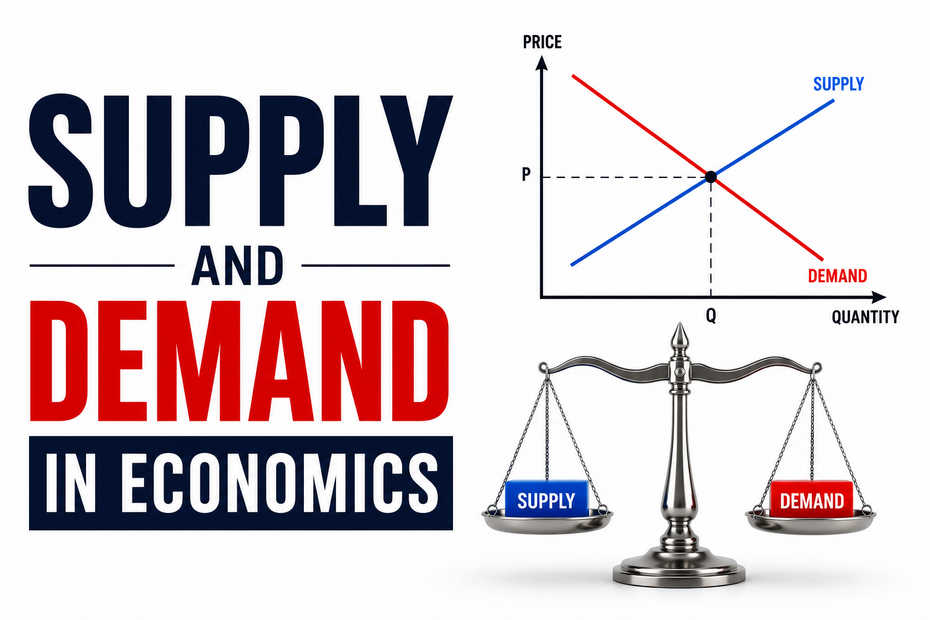
Supply and demand in economics are key concepts that explain how markets function, how prices are set, and why businesses, consumers, and investors make certain choices. Whether you are buying groceries, investing in stocks, evaluating a business, or studying the global economy, the relationship between supply and demand is crucial.
Every market worldwide is affected by these two forces. When demand for a product rises while supply stays limited, prices typically go up. When supply exceeds consumer demand, prices usually drop. Understanding this relationship helps individuals make smarter financial decisions and gives businesses better strategies.
For investors and financial professionals, knowing how supply and demand affect prices is vital. These forces impact everything from commodity prices and stock markets to housing markets and interest rates.
In this guide, we will explore what supply and demand mean in economics, how they operate, the principles behind them, and why they matter for businesses, consumers, and investors.
What Is Supply and Demand in Economics?
Supply and demand form an economic model that explains the connection between the availability of products or services and consumers’ desire to buy them.
In simple terms:
- Demand is how much consumers want a product or service and are willing to pay at a certain price.
- Supply is how much producers or sellers are willing to offer at a specific price.
The interaction between supply and demand sets the market price and the quantity of goods or services sold.
For example, if a new smartphone is launched with unique features, and millions want to buy it while only a few units are available, demand will exceed supply. Therefore, prices may rise.
Conversely, if companies produce more smartphones than buyers want, supplied goods will outnumber demand, causing sellers to cut prices to encourage purchases.
This basic economic principle applies to almost every market, including:
- Stock markets
- Real estate
- Consumer goods
- Energy markets
- Technology industries
- Global trade
Understanding Demand in Economics
Demand in economics represents how willing and able consumers are to purchase goods or services at various price levels.
Demand isn’t just about wanting something. A person may desire a luxury car, but if they cannot afford it, this does not create real market demand.
Economists define demand based on three key factors:
- Consumer desire for a product
- Purchasing power
- Willingness to pay a specific price
For instance, during winter, the need for warm clothing typically grows because more people require jackets and sweaters. Businesses respond by increasing their inventory to meet this need.
Types of Demand
Several types of demand are studied in economics:
1. Individual Demand
Individual demand refers to a single consumer’s desire for a specific product or service.
Example:
One person buying a laptop for personal use represents individual demand.
2. Market Demand
Market demand refers to the total demand for a product from all consumers within a market.
Example:
The overall demand for electric vehicles from millions of buyers represents market demand.
3. Derived Demand
Derived demand occurs when the need for one product depends on the demand for another.
Example:
The demand for computer chips rises when the demand for smartphones and electric vehicles increases.
Law of Demand Explained
The Law of Demand is a core concept in economics.
It states:
When the price of a product rises, the quantity demanded usually falls. When the price drops, the quantity demanded generally rises, assuming other factors stay constant.
This creates an inverse relationship between price and demand.
For example:
- If coffee prices rise significantly, some customers may buy less coffee or choose cheaper options.
- If coffee prices drop, more customers may buy it since it becomes more affordable.
This relationship is represented by a demand curve, which typically slopes downward from left to right.
Why Does Demand Decrease When Prices Rise?
Several reasons explain this behavior:
1. Purchasing Power Effect
When prices increase, consumers’ purchasing power declines. They may not be able to buy the same amount as they could before.
2. Substitution Effect
Consumers may opt for alternative products when prices rise.
Example:
If the price of one coffee brand goes up, customers might switch to a cheaper brand.
3. Changing Consumer Behavior
Higher prices can make consumers less willing to buy non-essential items.
Factors Affecting Demand
Demand isn’t solely determined by price. Other factors can also influence consumer demand.
1. Consumer Income
Income is a major factor affecting demand.
When people earn more, they often spend more on products and services.
Example:
A person with a higher income may spend more on travel, technology, or luxury goods.
2. Consumer Preferences and Trends
Shifts in consumer preferences can greatly impact demand.
For example:
The rising popularity of electric vehicles has boosted demand for EV-related products and technologies.
3. Prices of Related Goods
The prices of substitute and complementary products can affect demand.
Substitute Goods
Substitute goods are products that can replace one another.
Example:
Tea and coffee are substitute goods since consumers can select one or the other.
Complementary Goods
Complementary goods are products that are used together.
Example:
Smartphones and mobile data plans are complementary products.
4. Population Growth
An increasing population generally raises market demand since more consumers need goods and services.
5. Consumer Expectations
Future expectations about prices can influence current demand.
Example:
If consumers think house prices will rise in the future, many may buy homes sooner, thus boosting current demand.
Understanding Supply in Economics
Supply in economics refers to the quantity of goods or services that producers are willing to sell at different price levels.
Businesses determine supply based on factors such as:
- Production costs
- Technology
- Availability of resources
- Market prices
- Business expectations
For instance, if the price of wheat increases, farmers may grow more wheat because higher prices can mean higher profits.
Law of Supply Explained
The Law of Supply states:
When the price of a product rises, producers are generally willing to supply more of that product. When the price drops, producers might cut back on supply.
Unlike demand, supply typically has a positive relationship with price.
Example:
If oil prices increase, energy companies may invest more in production because higher prices can lead to greater profits.
This relationship creates an upward-sloping supply curve.
Factors Affecting Supply
Supply is affected by several factors, not just the selling price of a product. Businesses continually assess these factors to decide on production and sales.
1. Production Costs
The cost of producing goods has a direct impact on supply.
If the price of raw materials, labor, transportation, or energy goes up, businesses might cut back on production because their profit margins shrink.
For example:
If steel prices rise, car manufacturers might face higher production costs, which can lower the supply of cars available in the market.
Conversely, if production costs drop, companies can make more goods and increase supply.
2. Technology and Innovation
Improvements in technology can boost supply by making production quicker, cheaper, and more efficient.
For example:
Automation and artificial intelligence have helped many sectors increase productivity by shortening production times and lowering operational expenses.
When businesses produce more with fewer resources, the overall market supply tends to go up.
3. Availability of Resources
The availability of natural resources, raw materials, and skilled workers influences supply.
For example:
A shortage of semiconductor chips can lead to decreased production of cars, computers, and smartphones because manufacturers cannot complete enough finished products.
4. Number of Sellers in the Market
The number of businesses in a market affects total supply.
When more firms enter an industry, overall supply usually rises because there are more producers offering products.
For example:
The rise of electric vehicle makers has increased the supply of electric cars worldwide.
5. Government Policies and Regulations
Government decisions can shape supply through:
- Taxes
- Subsidies
- Import restrictions
- Regulations
For example:
Government subsidies for renewable energy companies can lead to more production of solar panels and clean energy products.
Supply and Demand Equilibrium Explained
The point where supply and demand meet is known as market equilibrium.
At equilibrium:
- The amount supplied matches the amount demanded.
- The market finds a balanced price.
- Buyers and sellers agree on how much to exchange.
The equilibrium price is also called the market-clearing price because products are sold without creating excess shortages or surpluses.
Example of Market Equilibrium
Consider a coffee market:
- Customers want to buy 10,000 cups of coffee each day.
- Coffee shops are ready to sell 10,000 cups daily.
At this stage, the market is even.
However:
- If coffee shops only produce 7,000 cups, a shortage happens.
- If they produce 15,000 cups, a surplus emerges.
The market price typically adjusts until supply and demand balance out again.
What Happens When Supply and Demand Change?
Markets are always shifting due to changes in consumer behavior, business choices, and economic situations.
1. Increase in Demand
When demand rises while supply stays the same:
- Prices usually go up.
- Businesses may ramp up production.
- Competition among buyers might intensify.
Example:
During a technology boom, demand for artificial intelligence companies surged, impacting their valuations and investment interest.
2. Decrease in Demand
When consumer demand decreases:
- Prices might drop.
- Businesses may cut back on production.
- Companies might offer discounts to draw in customers.
Example:
A fall in demand for outdated tech products often forces firms to lower their prices.
3. Increase in Supply
When supply grows:
- Products are more available.
- Prices may decrease.
- Consumers benefit from more choices.
Example:
As more companies enter the smartphone market, increased competition can lower prices.
4. Decrease in Supply
When supply drops:
- Products can become harder to find.
- Prices typically rise.
- Consumers might start looking for alternatives.
Example:
Natural disasters can disrupt agricultural production, leading to reduced food supply and higher prices.
Supply and Demand Curve Explained
Economists use graphs called supply and demand curves to understand market behavior.
Demand Curve
The demand curve illustrates the relationship between price and quantity demanded.
It typically slopes downward because:
- Higher prices lower demand.
- Lower prices boost demand.
Supply Curve
The supply curve shows the relationship between price and quantity supplied.
It usually slopes upward because:
- Higher prices encourage producers to supply more.
- Lower prices can decrease production incentives.
The point where both curves cross represents market equilibrium.
Understanding these curves helps economists, businesses, and investors interpret market trends.
Real-World Examples of Supply and Demand
1. Housing Market
The real estate market is strongly impacted by supply and demand.
When demand for housing goes up but new homes are scarce, property prices tend to rise.
Factors influencing housing demand include:
- Population growth
- Interest rates
- Employment opportunities
- Consumer confidence
For example:
Lower mortgage rates can motivate more people to buy homes, driving up demand.
2. Stock Market
Supply and demand also shape stock prices.
When many investors want to buy a company’s shares:
- Demand rises.
- Stock prices may increase.
When more investors want to sell shares than buy them:
- Supply increases.
- Prices may drop.
However, stock markets are also influenced by company performance, economic conditions, interest rates, and investor sentiment.
3. Oil and Energy Markets
Oil prices are particularly sensitive to changes in supply and demand.
If oil production falls due to supply issues, prices often increase.
If global production expands while demand stays steady, prices might decrease.
Why Supply and Demand Matter for Investors
Understanding supply and demand can help investors make smarter choices.
Investors apply these ideas to evaluate:
- Market trends
- Company growth prospects
- Industry cycles
- Commodity prices
- Consumer behavior
For example:
If a company is in an industry with rising demand and limited supply, it could show significant growth potential.
Nevertheless, investors should also consider other factors like financial performance, competition, and economic context.
Elasticity of Supply and Demand Explained
One of the key concepts related to supply and demand in economics is elasticity. Elasticity shows how much the quantity demanded or supplied changes in response to a change in price or other economic factors.
Businesses, economists, and investors look at price elasticity of demand and elasticity of supply to understand consumer behavior, pricing decisions, and market conditions.
For instance, if a small price increase for a product leads customers to stop buying it, demand is considered highly elastic. However, if customers keep purchasing even with higher prices, demand is considered inelastic.
What Is Price Elasticity of Demand?
Price elasticity of demand measures how much the quantity demanded of a product shifts when its price changes.
The formula is:
Price Elasticity of Demand = Percentage Change in Quantity Demanded ÷ Percentage Change in Price
There are three main types of demand elasticity:
1. Elastic Demand
Elastic demand occurs when a small price change leads to a large change in consumer demand.
Examples:
- Luxury goods
- Expensive electronics
- Entertainment products
If the price of a luxury watch goes up significantly, many consumers might choose not to buy it because they can wait or find alternatives.
2. Inelastic Demand
Inelastic demand happens when price changes have little effect on demand.
Examples:
- Essential medicines
- Basic food products
- Electricity
Consumers usually keep buying these products even when prices rise because they need them.
3. Unit Elastic Demand
Unit elastic demand occurs when the percentage change in demand matches the percentage change in price.
For example:
If the price of a product goes up by 10% and demand drops by 10%, the demand is considered unit elastic.
What Is Elasticity of Supply?
Elasticity of supply measures how much the quantity supplied changes when the price of a product changes.
When businesses can quickly ramp up production after a price increase, supply is more elastic.
Examples:
Technology companies can often boost production relatively quickly when demand goes up.
In contrast, industries like agriculture may have less elastic supply because crops depend on specific growing seasons and natural conditions.
How Supply and Demand Affect Inflation and the Economy
The link between supply and demand and inflation is crucial in modern economics.
Inflation happens when the general price level for goods and services rises over time. Changes in supply and demand are major drivers of price shifts.
Demand-Pull Inflation
Demand-pull inflation occurs when demand for goods and services rises faster than businesses can supply them.
When too many consumers compete for limited products:
- Prices rise
- Businesses boost production
- The overall cost of living may increase
Example:
After an economic recovery, consumers may spend more on travel, housing, and entertainment. If supply can’t keep pace, prices might rise.
Supply-Side Inflation
Supply-side inflation arises when production costs rise or supply decreases.
Common causes include:
- Higher energy prices
- Raw material shortages
- Supply chain issues
- Natural disasters
Example:
If global oil production drops, transportation costs may rise, leading to higher prices for many goods.
Impact of Supply and Demand Changes on the Economy
Changes in supply and demand influence:
- Consumer spending
- Business profits
- Employment
- Interest rates
- Investment decisions
A healthy economy requires a balance between production capacity and consumer demand.
Supply and Demand Strategies for Businesses
Successful businesses closely monitor their supply and demand strategy to make better decisions about production, pricing, and inventory.
Understanding customer demand helps companies avoid two major issues:
- Overproducing inventory
- Running out of products during peak demand
Demand Forecasting
Demand forecasting is the process of predicting future customer demand using market data, consumer trends, and historical information.
Businesses use forecasting to decide:
- How much inventory to keep
- How many products to produce
- When to expand operations
For instance:
Retail companies analyze past sales trends to prepare their inventory for holiday shopping seasons.
Pricing Decisions
Supply and demand help companies create effective pricing strategies.
When demand is high and supply is low, businesses may raise prices.
When supply surpasses demand, companies might lower prices or offer discounts.
A solid pricing strategy enables businesses to maximize revenue while keeping customers satisfied.
Managing Inventory
Inventory management closely relates to supply and demand.
Businesses need enough products to meet customer needs without creating excess inventory.
For example:
A smartphone company must estimate demand before launching a new model to prevent shortages or unsold stock.
How Investors Use Supply and Demand Analysis
Understanding supply and demand in investing helps investors analyze markets and make smarter decisions.
While financial markets respond to many factors, supply and demand remain fundamental to price movements.
Supply and Demand in the Stock Market
Stock prices are influenced by buying and selling pressure.
When more investors want to buy a stock:
- Demand goes up
- Buying pressure increases
- Stock price may rise
When more investors wish to sell:
- Supply increases
- Selling pressure rises
- Stock price may drop
Investors should also review:
- Company earnings
- Financial statements
- Industry trends
- Economic conditions
Supply and Demand in Commodity Markets
Commodities like oil, gold, and agricultural products are greatly affected by changes in supply and demand.
Examples:
- Lower oil production can drive up oil prices.
- Higher gold demand during uncertain times can elevate gold prices.
Investors analyze these changes to grasp market trends.
Real Estate Market Analysis
The real estate market showcases how supply and demand play a significant role.
When housing demand rises but available homes stay limited:
- Property prices may increase.
- Competition among buyers escalates.
When more homes are available than buyers:
- Prices may level off or drop.
Recognizing these patterns helps investors assess real estate opportunities.
Difference Between Supply and Demand
| Supply | Demand |
|---|---|
| Supply refers to the quantity producers offer for sale | Demand refers to the quantity consumers want to buy |
| Created by sellers and businesses | Created by consumers |
| Usually increases when prices rise | Usually decreases when prices rise |
| Represented by the supply curve | Represented by the demand curve |
| Focuses on production ability | Focuses on purchasing willingness |
Supply and Demand in Global Markets
In today’s interconnected world, supply and demand in global markets play a major role in setting prices, guiding business decisions, and driving economic growth. Products and services are no longer confined to a single country. A change in supply or demand in one region can impact markets around the globe.
Global supply and demand are influenced by many factors, including:
- International trade
- Population growth
- Economic development
- Technology
- Consumer preferences
- Government policies
Understanding these factors helps businesses, investors, and consumers predict market trends and make wiser financial choices.
International Trade and Supply
International trade allows countries to exchange goods and services. When a country produces more of a certain product than it needs, it can export the surplus to other nations.
For example:
A country with strong agricultural production might export grains, fruits, or other food products to countries with limited supply.
When global supply increases:
- Product availability improves
- Competition among sellers rises
- Prices may drop
However, when supply chains face disruptions, global supply can decrease.
Examples of supply disruptions include:
- Natural disasters
- Transportation problems
- Resource shortages
- Political conflicts
These events can raise production costs and lead to higher prices worldwide.
Global Demand Changes
Global demand shifts when consumers in various countries increase or decrease their spending on products and services.
Economic growth often boosts demand as people have higher incomes and greater purchasing power.
For example:
As developing economies expand, demand for:
- Technology products
- Vehicles
- Housing
- Financial services
often grows.
Businesses track global demand trends to decide where to expand, what products to develop, and how much inventory to keep.
Shortage and Surplus in Economics Explained
A balanced market occurs when supply meets demand. However, real-world markets often face situations where supply and demand don’t match.
Two key concepts that explain these situations are shortage and surplus in economics.
What Is a Shortage?
A shortage happens when the demand for a product exceeds the available supply.
In simple terms:
Demand > Supply = Shortage
When shortages arise:
- Products become hard to find
- Competition among buyers intensifies
- Prices usually increase
For instance:
If a new technology product becomes very popular but manufacturers can’t produce enough units, customers may have to wait longer or pay higher prices.
Causes of Shortages
Shortages can occur for several reasons:
1. Limited Production Capacity
Businesses may lack enough factories, workers, or resources to quickly ramp up production.
2. Supply Chain Problems
Delays in transportation or shortages of raw materials can limit product availability.
3. Sudden Increase in Demand
Unexpected changes in consumer behavior can create shortages.
Example:
During emergencies, demand for certain essential products may surge rapidly.
What Is a Surplus?
A surplus occurs when the supply of a product exceeds consumer demand.
In simple terms:
Supply > Demand = Surplus
When a surplus happens:
- Businesses may lower prices
- Companies may offer discounts
- Production levels may drop
For example:
If clothing companies produce too many seasonal items and customer interest fades, businesses may sell those products at reduced prices.
Causes of Surplus
Common causes of surplus include:
- Overproduction
- Incorrect demand forecasting
- Changes in consumer preferences
- Economic slowdown
Businesses use market analysis and demand forecasting to minimize the risk of surplus inventory.
Future Trends That Can Change Supply and Demand
The relationship between supply and demand continues to change as technology, consumer behavior, and global economic conditions evolve.
Understanding future trends helps businesses and investors prepare for upcoming market opportunities.
Artificial Intelligence and Automation
Artificial intelligence and automation are changing how companies produce goods and provide services.
Automation can help businesses:
- Increase production efficiency
- Lower operating costs
- Improve supply management
- Respond quickly to market demand
For instance:
Manufacturing companies are using advanced technologies to produce products faster while reducing errors.
As production becomes more efficient, supply capacity may grow across many industries.
Changing Consumer Preferences
Consumer preferences constantly shift due to technology, lifestyle changes, and awareness of environmental issues.
Some industries seeing rising demand include:
- Electric vehicles
- Renewable energy
- Online services
- Digital payment systems
- Smart technology
Companies that grasp changing consumer demand can create better products and maintain a competitive edge.
Global Economic Changes
Future patterns of supply and demand will also be shaped by major economic factors such as:
- Inflation rates
- Interest rates
- Population growth
- Income levels
- Global investment trends
For instance:
Higher interest rates may reduce demand for costly purchases like homes and vehicles because borrowing becomes more expensive.
Conversely, economic growth can boost consumer spending and create new business prospects.
Why Understanding Future Supply and Demand Matters
For businesses, understanding future market changes aids in:
- Better planning
- Improved pricing decisions
- Efficient inventory management
- Long-term growth strategies
For investors, analyzing supply and demand trends can help identify:
- Growing industries
- Market opportunities
- Potential risks
The ability to understand changing market forces is a valuable skill in today’s economics and finance.
Common Mistakes People Make Understanding Supply and Demand
1. Thinking Demand Means Only Wanting a Product
Demand isn’t just about desire. A consumer must have both the willingness and ability to buy.
2. Ignoring Other Market Factors
While supply and demand are key, prices are also influenced by:
- Inflation
- Interest rates
- Government policies
- Global events
3. Assuming Prices Always Move Immediately
Markets may take time to adjust since businesses and consumers do not change their behaviors right away.
Frequently Asked Questions (FAQs)
What is supply and demand in economics?
Supply and demand describe how product availability and consumer interest affect prices and market dynamics.
Why is supply and demand important?
Supply and demand guide businesses, investors, and consumers in understanding price fluctuations and market behavior.
What happens when demand is higher than supply?
When demand outpaces supply, shortages can arise, leading to higher prices.
What happens when supply is higher than demand?
When supply surpasses demand, businesses may lower prices to attract buyers.
How does supply and demand affect stock prices?
Increased investor demand for a stock can push prices up, while greater selling pressure can drive prices down.
Conclusion
Supply and demand in economics form the foundation of how markets work. These concepts clarify why prices change, how businesses make production choices, and how consumers impact economic activity.
From daily purchases to global financial markets, supply and demand play a role in nearly every economic decision. Grasping these principles helps people become smarter consumers, better investors, and more knowledgeable participants in the global economy.
For anyone studying economics, finance, investing, or business strategy, mastering supply and demand is essential because it provides a clear understanding of how markets operate.
As markets evolve due to technology, globalization, and consumer behavior, supply and demand will remain crucial tools for analyzing economic trends around the world.
Written by Finphantix