

Investing in the stock market is one of the best ways to build long-term wealth. Whether you’re in the United States, the United Kingdom, Canada, Australia, or anywhere in Europe, grasping the concept of stocks is a key step to becoming a smarter investor.
Many beginners buy stocks without really understanding what they represent. A stock is not just a ticker symbol moving up and down on a screen; it signifies ownership in a real business. When that business grows, innovates, and makes profits, shareholders can benefit through rising share prices and dividends.
As investing becomes easier in 2026, understanding the different types of stocks is more crucial than ever. Each stock category has a different purpose, offers unique opportunities, and comes with varying risks.
In this guide, you’ll learn what stocks are, how they work, the main stock categories every investor should know, and how to choose the right stocks for your financial goals.
What Are Stocks?

A stock represents a share of ownership in a company.
When you buy stock in a business, you become a shareholder. This means you own a small part of that company and can benefit from its future success.
Public companies sell shares through stock exchanges to raise money for business expansion, product development, acquisitions, hiring employees, and other growth efforts.
For investors, stocks offer a chance to participate in the growth of businesses and economies worldwide.
How Do Stocks Work?
Stock prices change constantly based on supply and demand.
When investors believe a company’s future is promising, demand for its shares increases and often pushes prices higher. If expectations decline, investors may sell shares, leading to lower prices.
Investors typically earn money from stocks in two ways:
Capital Appreciation
When the stock price rises above the purchase price.
Dividend Income
When a company distributes a portion of its profits to shareholders.
Over time, successful companies usually grow their earnings, which can lead to long-term stock price appreciation.
Why Companies Issue Stocks
New investors often understand why people buy stocks but may not see why companies sell them.
The answer is simple: businesses need money to grow.

By issuing shares, companies can raise funds without incurring significant debt. The money raised can be used to:
- Expand operations
- Launch new products
- Enter new markets
- Fund research and development
- Reduce debt
- Acquire other businesses
In return, investors gain ownership in the company and the chance to benefit from future growth.
Why Stocks Matter for Wealth Building
Throughout history, stocks have been one of the most effective tools for creating wealth.
Unlike cash savings, which can lose value due to inflation, stocks allow investors to participate in economic growth and corporate profits.
Stocks play a critical role in:
- Retirement planning
- Wealth building
- Passive income strategies
- Financial independence goals
While short-term ups and downs are unavoidable, long-term investors have historically been rewarded for staying invested.
Benefits of Investing in Stocks
Stocks offer several advantages compared to many other asset types.
Potential for Long-Term Growth
Stocks have historically provided strong returns over long periods.
Inflation Protection
Businesses often raise prices as costs rise, helping investors keep their purchasing power.
Dividend Income
Some companies regularly share profits with shareholders through dividends.
Liquidity
Stocks can usually be bought and sold quickly through major exchanges.
Accessibility
Investors can start with relatively small amounts of money.
Global Opportunities
Modern investors can access companies from around the world.
Risks of Investing in Stocks
Every investment carries risk, and stocks are no exception.
Market Risk
Stock prices can fall during economic downturns.
Company-Specific Risk
Poor management choices or business challenges can negatively affect performance.
Volatility
Short-term price swings can be significant.
Economic Risk
Inflation, interest rates, and recessions can impact stock valuations.
Emotional Risk
Fear and greed often lead investors to make poor decisions.
Successful investors focus on managing risk rather than trying to eliminate it completely.
Common Stock vs Preferred Stock
The two main categories of stocks are common stock and preferred stock.
Common Stock
Common stock is the type most investors buy.
Features include:
- Voting rights
- Potential dividends
- Higher long-term growth potential
- Ownership participation
Best For
- Long-term investors
- Growth-focused investors
- Retirement portfolios
Preferred Stock
Preferred stock combines features of stocks and bonds.
Features include:
- Fixed dividend payments
- Dividend priority
- Higher claim on assets during liquidation
However, preferred shareholders typically do not have voting rights.
Best For
- Income-focused investors
- Conservative investors
- Dividend seekers
Types of Stocks Every Investor Should Know
Understanding stock categories can help investors build stronger and more diverse portfolios.

Growth Stocks
Growth stocks belong to companies expected to grow revenue and earnings faster than the overall market.
These companies often reinvest profits into future expansion instead of paying large dividends.
Characteristics
- High growth potential
- Higher volatility
- Lower dividends
- Innovation-driven businesses
Advantages
- Significant upside potential
- Strong long-term wealth creation
Risks
- Greater market volatility
- Higher valuation risk
Value Stocks
Value stocks trade below what investors believe is their true worth.
These companies may be temporarily overlooked despite having solid fundamentals.
Characteristics
- Lower valuation metrics
- Established businesses
- Often pay dividends
Advantages
- Potential undervaluation opportunities
- Lower downside risk
Risks
- Slower growth
- Can remain undervalued for long periods
Dividend Stocks
Dividend stocks regularly share profits with shareholders.
These stocks are popular among investors seeking passive income.
Characteristics
- Consistent dividend payments
- Stable earnings
- Mature businesses
Advantages
- Reliable income stream
- Potential downside protection
Risks
- Lower growth potential than some growth stocks
Blue-Chip Stocks
Blue-chip stocks are shares of large, financially strong companies with long histories of success.
Characteristics
- Strong balance sheets
- Global recognition
- Consistent profitability
Advantages
- Stability
- Reliability
- Long-term wealth creation
Risks
- Slower growth than smaller companies
Income Stocks
Income stocks are bought mainly for dividend income rather than rapid capital appreciation.
They are often favored by:
- Retirees
- Conservative investors
- Income-focused portfolios
Cyclical Stocks
Cyclical stocks usually perform well when the economy is growing but struggle during economic slowdowns.
Examples
- Travel companies
- Automotive businesses
- Luxury brands
- Manufacturing firms
Advantages
- Strong performance during expansions
Risks
- Sensitive to recessions
Defensive Stocks
Defensive stocks provide products and services consumers continue to buy regardless of economic conditions.
Examples
- Healthcare
- Utilities
- Consumer staples
- Household essentials
Advantages
- Lower volatility
- Greater stability
Risks
- May underperform during strong bull markets
Large-Cap, Mid-Cap, and Small-Cap Stocks
Stocks are often classified based on company size.
Large-Cap Stocks
- Established businesses
- Lower risk
- Greater stability
Mid-Cap Stocks
- Balance between growth and stability
- Moderate risk
Small-Cap Stocks
- Higher growth potential
- Higher volatility
- Greater risk
A diverse portfolio often includes exposure to all three categories.
Domestic vs International Stocks
Investors are no longer limited to companies in their home country.
International investing offers:
- Geographic diversification
- Access to emerging markets
- Reduced country-specific risk
Many successful portfolios combine domestic and international stocks.
ESG Stocks
ESG stands for Environmental, Social, and Governance.
These companies focus on sustainability, ethical business practices, and responsible corporate governance.
ESG investing attracts those seeking both financial gains and social impact.
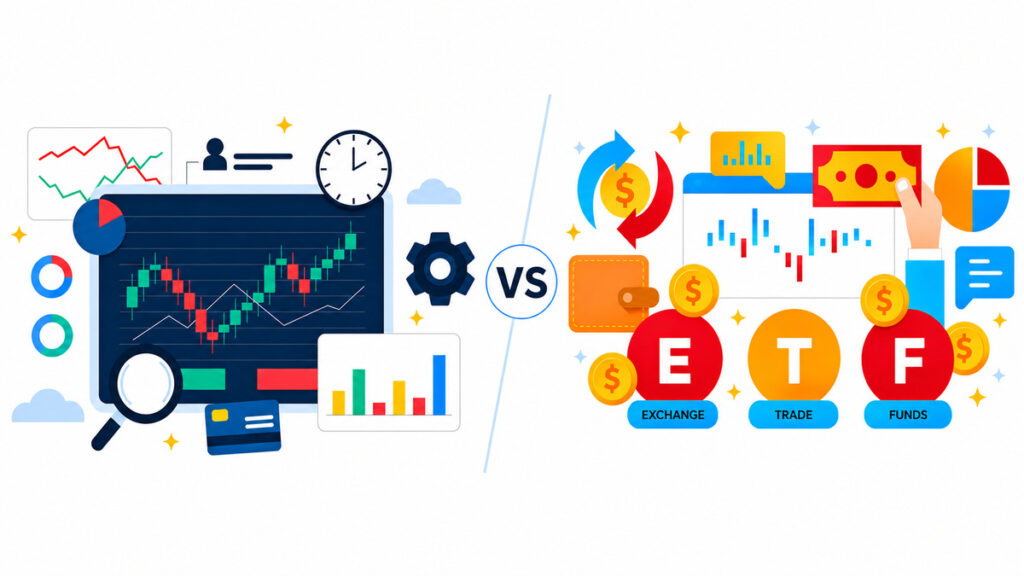
Stocks vs ETFs: What’s the Difference?
Many beginners wonder whether to buy individual stocks or ETFs.
| Feature | Stocks | ETFs |
|---|---|---|
| Ownership | Single Company | Multiple Companies |
| Diversification | Low | High |
| Risk | Higher | Lower |
| Research Required | More | Less |
| Beginner Friendly | Moderate | High |
ETFs are often seen as a great starting point for new investors because they offer instant diversification.
How Stocks Generate Returns for Investors
Stocks generate returns in two main ways.
Capital Gains
If a stock rises in value after purchase, investors can profit by selling it at a higher price.
Dividends
Some companies distribute a portion of profits to shareholders.
Many successful investors gain from both capital appreciation and dividend income.
Which Type of Stock Is Best for Beginners?
Choosing the right stocks as a beginner can feel overwhelming, especially with thousands of publicly traded companies available worldwide. While no single stock is perfect for everyone, some types of stocks are generally considered more beginner-friendly than others.
For most new investors, the goal should be to balance growth potential with risk management. Instead of chasing the latest market trend or trying to find the next big winner, beginners often benefit from focusing on high-quality businesses with strong financial foundations.
Many first-time investors start with:
- Blue-chip stocks
- Dividend-paying stocks
- Large-cap companies
- Broad market ETFs
- Index funds
These investments usually provide greater stability and diversification than speculative stocks. They also allow investors to gain experience while lowering the chance of making costly mistakes.
The most important lesson for beginners is that successful investing is rarely about finding the perfect stock. It’s about building a diversified portfolio and staying invested for the long term.
How to Buy Stocks in 2026
Investing in stocks has never been more accessible. Modern brokerage platforms let investors buy shares from almost anywhere in the world with just a few clicks.
Step 1: Open a Brokerage Account
Choose a reputable, regulated brokerage platform that gives you access to the markets you want to invest in.
Step 2: Define Your Investment Goals
Before buying any stock, figure out what you want to achieve. Are you investing for retirement, passive income, long-term wealth, or another financial goal?
Step 3: Research the Company
Understand how the company makes money, its competitive edges, financial performance, and future growth potential.
Step 4: Diversify Your Portfolio
Avoid putting all your money in one company or sector. Diversification can help lower overall portfolio risk.
Step 5: Invest Consistently
Many successful investors take a disciplined approach by investing regularly instead of trying to predict short-term market movements.
Step 6: Think Long Term
The stock market can be unpredictable in the short term, but long-term investors often benefit from keeping their focus on their goals rather than reacting to daily market news.
How to Choose the Right Stocks
Choosing the right stocks requires more than just looking at recent price changes. Smart investors evaluate companies based on their fundamentals and long-term potential.
Before investing, think about these questions:
What Is Your Risk Tolerance?
Some stocks have significant price swings, while others are more stable. It’s important to know how much risk you can handle comfortably.
What Is Your Investment Time Horizon?
Investors with longer time frames may be able to take on more risk because they have time to recover from market downturns.
What Are Your Financial Goals?
Different stocks serve different purposes. Growth investors may focus on capital gains, while income investors may look for dividends.
Is the Company Financially Strong?
Look for companies with healthy revenue growth, manageable debt, strong cash flow, and a sustainable competitive edge.
Are You Properly Diversified?
Even great companies can face unexpected challenges. Diversification helps protect your portfolio from company-specific risks.
Common Stock Investing Mistakes
Even experienced investors make mistakes from time to time. Understanding common investing errors can help beginners avoid unnecessary losses.
Chasing Hot Stocks
Buying stocks just because everyone is talking about them can lead to bad investment choices.
Ignoring Diversification
Putting too much money in one stock increases risk significantly.
Trading Too Frequently
Buying and selling often can increase costs and often hurt long-term results.
Investing Based on Emotions
Fear and greed are two major enemies of successful investing.
Following Social Media Hype
Not every popular stock idea is a good investment. Always do your own research before deciding.
Focusing Only on Stock Price
A low stock price doesn’t necessarily mean a stock is cheap, and a high stock price doesn’t automatically mean it’s expensive.
Successful investing usually requires patience, discipline, and a long-term viewpoint instead of short-term speculation.
Are Stocks a Good Investment in 2026?
Despite changing market conditions, stocks remain one of the best tools for building long-term wealth.
Global economies evolve, industries change, and new technologies appear, but owning shares in successful companies continues to be a strong wealth-building strategy.
Investors who focus on:
- High-quality companies
- Portfolio diversification
- Consistent investing
- Long-term strategies
- Risk management
often position themselves better to reach their financial goals.
While no investment is guaranteed to make profits, stocks have historically rewarded patient investors who stick to a solid plan.
For those seeking long-term growth, financial freedom, and wealth creation, stocks remain an important part of a diversified investment portfolio.
Frequently Asked Questions
Are Stocks Better Than Saving Money?
Stocks generally offer more long-term growth potential than traditional savings accounts. However, they also come with higher risk and short-term fluctuations. Savings accounts provide stability, while stocks provide opportunities for capital gains.
Can Beginners Invest in Stocks?
Yes. Many successful investors started with little experience. Beginners can start by learning the basics, investing gradually, and focusing on diversified options like blue-chip stocks, ETFs, and index funds.
What Is the Difference Between Growth and Value Stocks?
Growth stocks are expected to increase earnings quickly, while value stocks are seen as undervalued compared to their fundamentals. Both can play important roles in a diversified portfolio.
Are Dividend Stocks Good for Long-Term Investing?
Dividend stocks can be excellent long-term investments because they provide regular income along with the potential for capital growth over time.
How Much Money Do I Need to Start Investing in Stocks?
Many brokerage platforms now let investors start with relatively small amounts of money. Fractional shares and low-cost options make stock investing more accessible than ever.
Final Thoughts

Understanding stocks is one of the most valuable financial skills an investor can develop. Although the stock market may seem complicated at first, the basic idea is quite simple: when you buy a stock, you become a part-owner of a company.
The key to successful investing is recognizing that different types of stocks serve various purposes. Growth stocks can help speed up wealth creation, dividend stocks can provide passive income, blue-chip stocks can offer stability, and defensive stocks can help reduce portfolio volatility during uncertain economic times.
Instead of chasing trends or reacting to short-term headlines, focus on building a diversified portfolio that matches your financial goals, risk tolerance, and investment timeline. Long-term success in the stock market is rarely about finding the perfect stock. It’s about making informed decisions, staying disciplined, and allowing time and compounding to work for you.
As we move through 2026 and beyond, investors who understand how stocks work and how different stock types fit into a portfolio will be better equipped to handle market ups and downs and build lasting wealth over the long term.
Written by Finphantix