
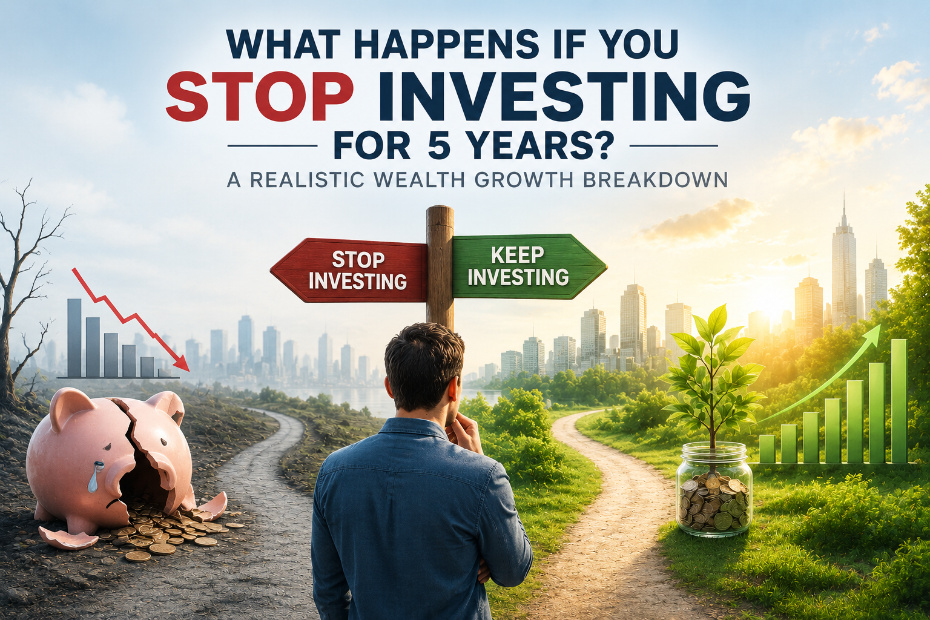
There is a common misunderstanding among new and even mid-level investors in the US, UK, and Europe.
Many people think investing is flexible. They believe they can pause during busy times and restart later without facing serious consequences.
From a financial planning standpoint, that idea is not entirely right.
Investing isn’t just a financial task; it forms a long-term compounding system that relies on consistency, time, and discipline. When you interrupt that system for 5 years, you may not see the impact right away. However, as time goes on, the effects become more significant.
In this article, I will explain what really happens when you stop investing for 5 years. I will base this on real financial logic, compounding behavior, and long-term wealth structure—not on theory or motivational content.
Understanding What “Stopping Investing” Actually Means
When someone mentions they stopped investing, it doesn’t mean their money immediately disappears or loses value.
The reality is more complex.

When you stop investing:
- Your existing investments stay active in the market.
- They continue to grow or fluctuate depending on market conditions.
- But no new money is added to the system.
- The compounding engine loses momentum over time.
Your money still works, but only to a limited extent.
The key point here is this:
Wealth creation relies not just on returns; it also depends on a steady inflow of capital combined with time.
When you stop that inflow, the system slows down.
The Real Engine of Wealth: Consistency, Capital, and Time
Most beginners believe that success in investing comes from selecting the right stock or fund.
However, in long-term wealth building, especially in developed markets like the US and Europe, the real factors are much simpler:
- Consistent investing behavior
- A long time horizon
- Reinvestment of returns
- Emotional discipline during market cycles
When these elements work together, wealth can grow at an accelerated pace.
But when investing stops, one critical factor disappears: the consistency of capital inflow.
This creates an imbalance in your financial growth model.
Instead of exponential compounding, you get limited compounding based solely on previous capital.
Why Compounding Needs Continuous Fuel
Compounding is often described as “interest on interest,” but that only tells part of the story.
In actual investing behavior, compounding gains power because:
- New money enters the system regularly.
- Each investment has its unique growth timeline.
- Gains are reinvested, which builds on previous gains.
So, you aren’t just growing your money; you are creating multiple layers of growth at the same time.
When investing stops:
- New layers stop forming.
- Only existing layers continue to grow.
- The system becomes static instead of expanding.
This is where a long-term gap begins to form between consistent investors and those who take a break.
A Realistic Market Example (Global Perspective)
Let’s look at a straightforward and realistic scenario relevant to global markets like the S&P 500, FTSE 100, or European index funds.
Assumptions:
- Monthly investment: $300
- Average annual return: 8-10% (long-term equity average)
- Time period: 10 years
- Two investors with the same starting point
We will compare two investors:
Investor A vs Investor B

Investor A – Consistent Investor
- Invests $300 every month for 10 years without interruption.
- Ends up investing through all market cycles.
Investor B – Stops After 5 Years
- Invests $300 every month during the first 5 years.
- Then completely stops for the next 5 years.
In the beginning, both investors follow the same path. After 5 years, both seem financially similar.
First 5 Years: Everything Appears Normal
After 5 years of consistent investing:
- Total invested: $18,000
- Estimated portfolio value: $23,000 to $26,000
At this stage, many investors feel confident. There’s no visible issue. Returns look good. The portfolio is growing.
This is exactly where many people make the mistake of pausing their investing. The consequences aren’t immediate; they show up later.
Years 6 to 10: Where the True Financial Gap Emerges
After year 5, the two investors begin to diverge significantly.
Investor A (Continues Investing)
Investor A keeps investing $300 monthly for another 5 years.
- Additional investment: $18,000
- Total investment after 10 years: $36,000
By year 10:
- Portfolio value: around $55,000 to $65,000
This includes:
- Contributions
- Market returns
- Compounding on both old and new investments
Investor B (Stops Investing)
Investor B stops investing after year 5.
- No new contributions for 5 years.
- Only the existing $18,000 continues to compound.
By year 10:
- Portfolio value: around $30,000 to $38,000
The Hidden Reality Behind the Gap
At first glance, the difference may not seem dramatic.
However, financially, the real issue isn’t just the final number. It’s what did NOT happen during those 5 years.
Let’s break it down.
1. Loss of Compounding Layers
Every monthly investment creates a new compounding cycle.
Over time, Investor A builds numerous overlapping growth cycles.
Investor B stops forming new cycles after year 5.
So while Investor A has multiple growth streams working together, Investor B has just one aging system.
This creates the first significant structural gap.
2. Time Is a Non-Recoverable Asset
One of the most crucial principles in investing is:
Time in the market is more important than timing the market.
When you stop investing for 5 years, you permanently lose those 5 years of compounding on new contributions.
Even if you start again later, you cannot recover the lost advantage of time.
This is why early consistency is so impactful.
3. Market Cycles Are Part of Growth
Markets do not grow in a straight line.
They move through:
- Bull markets
- Bear corrections
- Recovery phases
- Expansion cycles
Consistent investing ensures you participate in all phases.
When you stop investing, you miss entire sections of these cycles, particularly recovery phases where long-term gains often speed up.
Inflation: The Silent Wealth Eroder
Inflation is one of the most overlooked factors in personal finance.
Even if your money grows during the 5-year pause, inflation diminishes real value over time.

For instance:
- $30,000 today will not have the same purchasing power in 10 years.
- Real value may be significantly lower depending on inflation rates.
This means the gap between Investor A and Investor B is even larger in real terms than it appears numerically.
Psychological Impact: The Invisible Cost
In my experience, the most significant long-term damage isn’t financial; it’s behavioral.
When someone stops investing:
1. Habit Disruption
The investing habit weakens quickly. It becomes mentally harder to restart over time.
2. Risk Perception Changes
After a break, markets seem more uncertain or intimidating.
3. Delay Effect
People repeatedly postpone restarting, often thinking:
“I will start again next year.”
This leads to a long-term cycle of inactivity.
Over time, this change in behavior often proves more damaging than the financial gap itself.
The “I Can Restart Later” Misconception
Many investors think stopping temporarily is harmless since they can restart later.
Technically, this is true.
Financially, it’s incomplete.
When you restart:
- You come back from a lower base.
- You lose previous compounding momentum.
- You always lag behind continuous investors.
Even if you invest more later, you cannot fully recreate the lost compounding time.
Common Reasons People Stop Investing
Many people pause or stop investing due to changes in their financial situation or market conditions. Knowing these reasons can help you make better choices when challenges come up.
1. Job Loss or Reduced Income
Losing a job or experiencing a drop in income is a common reason people stop investing. When money gets tight, basic expenses often take priority over investing.
2. Unexpected Emergencies
Unexpected costs, like medical bills, car repairs, home maintenance, or family emergencies, can force investors to pull money away from their investment plans.
3. Fear During Market Declines
Many individuals stop investing when the market goes down because they fear losing more money. However, this can cause them to miss out on opportunities when the market improves.
4. High Debt Obligations
Paying off high-interest debt may take precedence, leaving less money for investing.
5. Major Life Changes
Events such as marriage, having kids, buying a house, or switching careers can lead to higher expenses and make it harder to invest.
6. Economic Uncertainty
Worries about inflation, recessions, or the overall economy often lead investors to hold back or stop their contributions.
While these reasons are understandable, staying invested, or even contributing a smaller amount when possible, can help maintain the long-term benefits of compound growth.
Why Consistency Beats Everything Else
In global financial markets, one principle remains clear:
Consistency is more powerful than timing, prediction, or market knowledge.
You do not need perfect investments to build wealth.
You need:
- Regular contributions.
- A long time horizon.
- Emotional discipline.
Even modest, consistent investing typically outperforms irregular large investments over time.
A More Realistic Strategy (What You Should Do Instead)
Sometimes, stopping investing is unavoidable due to real-life situations like job loss, emergencies, or rising expenses.
But from a financial planning perspective, a better approach is:
- Reduce contributions instead of stopping completely.
- Maintain the habit, even with small amounts.
- Restart gradually when your financial situation improves.
This keeps the compounding structure active, even during challenging times.
Frequently Asked Questions (FAQs)
1. What happens if I stop investing for 5 years?
If you stop investing for five years, your current investments may continue to grow. However, you will miss out on new contributions and the compounding returns they could have generated. This can greatly reduce your long-term wealth.
2. Will my money keep growing if I stop investing?
Yes, if your investments stay in the market, they can still grow based on market performance. However, the growth will likely be slower than if you continued making regular investments.
3. How much can I lose by not investing for 5 years?
The exact amount depends on your investment returns and contribution rate. Missing five years of investments could cost you thousands, or even lakhs, in future wealth because of lost compound growth.
4. Should I withdraw my investments if I stop contributing?
Not necessarily. In many cases, keeping your investments active lets them benefit from market growth and compounding.
5. Can I restart investing after a 5-year break?
Absolutely. Restarting as soon as possible can help you rebuild momentum and improve your long-term financial outlook, though catching up may need higher contributions.
6. Does stopping investing affect retirement goals?
Yes. A long break in investing can delay retirement goals because you miss valuable years of compound growth and portfolio accumulation.
7. Is it better to invest a small amount than stop completely?
Generally, yes. Even small, consistent contributions can help you maintain investment discipline and keep compounding working for you.
8. What is the biggest risk of stopping investing?
The biggest risk is the opportunity cost—missing potential market gains and compound returns that could have significantly increased your wealth over time.
Final Thoughts
Stopping investing for 5 years does not eliminate wealth.

However, it does something more subtle and often more harmful:
- It slows down wealth accumulation.
- It disrupts compounding momentum.
- It lowers long-term financial efficiency.
- It delays financial independence.
In real-world investing, the difference between those who build significant wealth and those who struggle financially is rarely intelligence or income.
It comes down to consistency over time.
And with investing, time is the one asset you can never recover once it is lost.
Written by Finphantix